



الصفحة 18
الصفحة 18
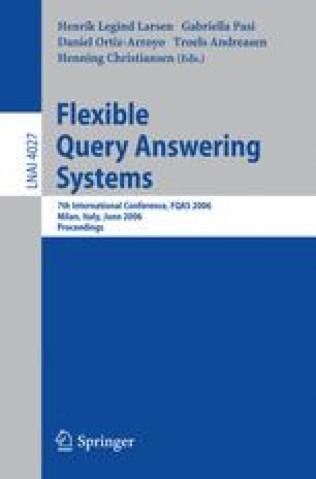
Flexible Query Answering Systems ; 7th International Conference, FQAS 2006, Milan, Italy, June 7-10, 2006
This book constitutes the refereed proceeding of the 7th International Conference on Flexible Query Answering Systems, FQAS 2006, held in Milan, Italy in June 2006. The 60 revised full papers presented were carefully reviewed and selected from numerous submissions. The papers are organized in topical sections on flexibility in database management and quering, vagueness and uncertainty in XML quering and retrieval, information retrieval and filtering, multimedia information access, user modeling and personalization, knowledge and data extraction, intelligent information extraction from text, and knowledge representation and reasoning.

Flexible and Efficient Information Handling ; 23rd British National Conference on Databases, BNCOD 23, Belfast, Northern Ireland, UK, July 18-20, 2006, Proceedings
This book constitutes the refereed proceedings of the 23rd British National Conference on Databases, BNCOD 23, held in Belfast, Northern Ireland, July 2006. The volume presents 12 revised full papers and 6 revised short papers, together with 2 invited lectures and 13 poster papers. Topical sections include data modelling and architectures and transaction management, data integration and interoperability and information retrieval, query processing and optimisation, data mining, data warehousing and more.
Finite model theory and its applications
This book gives a broad overview of core topics of finite model theory: expressive power, descriptive complexity, and zero-one laws, together with selected applications to database theory and artificial intelligence, especially, constraint databases and constraint satisfaction problems. The final chapter provides a concise modern introduction to modal logic, which emphasizes the continuity in spirit and technique with finite model theory. This underlying spirit involves the use of various fragments of, and hierarchies within, first order, second order, fixed point, and infinitary logics to gain insight into phenomena in complexity theory and combinatorics.

Financial cryptography and data security ; FC 2020 International Workshops, AsiaUSEC, CoDeFi, VOTING, and WTSC, Kota Kinabalu, Malaysia, February 14, 2020, Revised Selected Papers
This book constitutes the refereed proceedings of two workshops held at the 24th International Conference on Financial Cryptography and Data Security, FC 2020, in Kota Kinabalu, Malaysia, in February 2020. The 39 full papers and 3 short papers presented in this book were carefully reviewed and selected from 73 submissions. The papers feature four Workshops: The 1st Asian Workshop on Usable Security, AsiaUSEC 2020, the 1st Workshop on Coordination of Decentralized Finance, CoDeFi 2020, the 5th Workshop on Advances in Secure Electronic Voting, VOTING 2020, and the 4th Workshop on Trusted Smart Contracts, WTSC 2020.

Finance 4.0 - towards a socio-ecological finance system : A participatory framework to promote sustainability
The first is Bitcoin that infamously pursues a state-independent, decentralized conception of money. The second is Finance 4.0, a system that proposes a participatory multi-dimensional money system with built-in incentives for sustainable behavior
Field-Based Coordination for Pervasive Multiagent Systems
Software systems involve autonomous and distributed software components that have to execute and interact in open and dynamic environments, such as in pervasive, autonomous, and mobile applications. The requirements with respect to dynamics, openness, scalability, and decentralization call for new approaches to software design and development, capable of supporting spontaneous configuration, tolerating partial failures, or arranging adaptive reorganization of the whole system.
Federation over the Web ; International Workshop, Dagstuhl Castle, Germany, May 1-6, 2005, Revised Selected Papers
The lives of people all around the world, especially in industrialized nations, continue to be changed by the presence and growth of the Internet. Its in?uence is felt at scales ranging from private lifestyles to national economies, boosting thepaceatwhichmoderninformationandcommunicationtechnologiesin?uence personal choices along with business processes and scienti?c endeavors. In addition to its billions of HTML pages, the Web can now be seen as an open repository of computing resources. These resources provide access to computational services as well as data repositories, through a rapidly growing variety of Web applications and Web services.

Fault Diagnosis and Tolerance in Cryptography ; 3rd International Workshop, FDTC 2006, Yokohama, Japan, October 10, 2006, Proceedings
The sophistication of the underlying cryptographic algorithms, the high complexity of the implementations, and the easy access and low cost of cryptographic devices resulted in increased concerns regarding the reliability and security of crypto-devices. The effectiveness of side channel attacks on cryptographic devices, like timing and power-based attacks, has been known for some time. Several recent investigations have demonstrated the need to develop methodologies and techniques for designing robust cryptographic systems (both hardware and software) to protect them against both accidental faults and maliciously injected faults with the purpose of extracting the secret key. This trend has been particularly motivated by the fact that the equipment needed to carry out a successful side channel attack based on fault injection is easily accessible at a relatively low cost (for example, laser beam technology), and that the skills needed to use it are quite common.

Fast Track to MDX
Fast Track to MDX gives you all the necessary background to let you to write useful, powerful MDX expressions and introduces the most frequently used MDX functions and constructs. No prior knowledge is assumed and examples are used throughout the book to rapidly develop your MDX skills to the point where you can solve real business problems.

Fashionity
This project is an AI fashion design system to generate fashion images based on user textual description. The proposed system incorporates advanced technology for dissemination and machine translation with the aim of facilitating a seamless user experience for input in both Arabic and English languages. Moreover, the project encompasses the incorporation of a recommendation system that proposes appropriate visual content based on user style. The primary objective of this project is to develop a robust framework capable of generating high-quality images based on textual descriptions, providing recommendations for similar clothing items, and facilitating the retrieval of photographic and apparel articles through image search.

Fashion forge
"Fashion forge" revolutionizes clothing shopping with a cutting-edge mobile application. This AI-powered platform empowers users to describe their dream garment and visualize it instantly, bridging the gap between imagination and reality for fashion-forward users and designers. A recommendation system tailors clothing suggestions based on user preferences, while stores leverage a dedicated social platform for effective marketing. "Fashion Forge" fosters a connected fashion community, empowering users, designers, and stores alike.

Fadfada
Sharing personal problems and true feeling on social media has a lot of fears and is not likable nowadays, because of bullying, shaming, and making fun of the user by other users, Fadfada is a multi-platform social networking service, that aims to give the users the ability to share their problems or feeling via written newsfeed (posts) or videos (stories) that had an impact on their psychological health without revealing their true identity, by putting a mask on their faces and changing their voices after recording the story. In addition to extracting features from posts and stories to match users based on it.

Facebook API Developers Guide
The Facebook API allows web developers to create Facebook applications and access Facebook data from other applications. Facebook API Developers Guide covers the use and implementation of the Facebook API—what the key features are and how you can access them. You will learn, through practical examples, the main features of the Facebook API including an introduction to the API–specific languages FQL and FBML. These examples are further supported by the introduction of other technologies like language libraries, relational database management systems, and XML. Covers all key features of the Facebook API Explains the API languages FQL and FBML Teaches by example, with useful code and tips you can use in your own applications
Face Biometrics for Personal Identification : Multi-Sensory Multi-Modal Systems
This book provides an ample coverage of theoretical and experimental state-of-the-art work as well as new trends and directions in the biometrics field. It offers students and software engineers a thorough understanding of how some core low-level building blocks of a multi-biometric system are implemented. While this book covers a range of biometric traits including facial geometry, 3D ear form, fingerprints, vein structure, voice, and gait, its main emphasis is placed on multi-sensory and multi-modal face biometrics algorithms and systems. "Multi-sensory" refers to combining data from two or more biometric sensors, such as synchronized reflectance-based and temperature-based face images. "Multi-modal" biometrics means fusing two or more biometric modalities, like face images and voice timber. The first part addresses new and emerging face biometrics. Emphasis is placed on biometric systems where single sensor and single modality are employed in challenging imaging conditions. The second part on multi-sensory face biometrics deals with the personal identification task in challenging variable illuminations and outdoor operating scenarios by employing visible and thermal sensors. The third part of the book focuses on multi-modal face biometrics by integrating voice, ear, and gait modalities with facial data. The last part presents generic chapters on multi-biometrics fusion methodologies and performance prediction techniques.
Eye Tracking Methodology : Theory and Practice
Despite the availability of cheap, fast, accurate and usable eye trackers, there is still little information available on how to develop, implement and use these systems. This second edition of Andrew Duchowski’s successful guide to these systems contains significant additional material on the topic and fills this gap in the market with this accessible and comprehensive introduction. Opening with useful background information, including an introduction to the human visual system and key issues in visual perception and eye movement, the second part surveys eye-tracking devices and provides a detailed introduction to the technical requirements necessary for installing a system and developing an application program. The book focuses on video-based, corneal-reflection eye trackers – the most widely available and affordable type of system, before closing with a look at a number of interesting and challenging applications in human factors, collaborative systems, virtual reality, marketing and advertising.

Explicit Stability Conditions for Continuous Systems : A Functional Analytic Approach
Explicit Stability Conditions for Continuous Systems deals with non-autonomous linear and nonlinear continuous finite dimensional systems. Explicit conditions for the asymptotic, absolute, input-to-state and orbital stabilities are discussed. This monograph provides new tools for specialists in control system theory and stability theory of ordinary differential equations, with a special emphasis on the Aizerman problem. A systematic exposition of the approach to stability analysis based on estimates for matrix-valued functions is suggested and various classes of systems are investigated from a unified viewpoint.

Expert SQL Server 2005 Development
This book starts by reintroducing the database as a integral part of the software development ecosystem. You'll learn how to think about SQL Server development as you would any other software development.

Expert Oracle JDBC Programming
JDBC is the most commonly used API in Java to access and manipulate data in a database. Oracle is one of the most popular and scalable databases in the world. This book is a must-have for any developer building an application that employs JDBC on Oracle database. Unlike other JDBC books, this book has been written to complement not rehash the contents of Oracle JDBC documentation and the JDBC specification. The book teaches you not just how to write JDBC code, but how to write effective JDBC code in a step-by-step fashion. This book does not assume any prior knowledge of JDBC, though it does assume basic knowledge of SQL and PL/SQL. It covers JDBC with a focus on writing high-performing, scalable and secure applications for Oracle 10g and 9i.
Expert Oracle Database Architecture : 9i and 10g Programming Techniques and Solutions
This is a defining book on the Oracle database for any developer or database administrator who works with Oracle-driven database applications. Tom Kyte has a simple philosophy: you can treat Oracle as a black box and just stick data into it or you can understand how it works and exploit it as a powerful computing environment. If you choose the latter, then you will find that there are few information management problems that you cannot solve quickly and elegantly. Expert Oracle Database Architecture is the first of a three-book series that completely explores and defines the Oracle database. It covers all of the most important Oracle architecture features, including: Files, memory structures and processes / Locking and latching / Transactions, concurrency and multi-versioning / Tables and Indexes / Datatypes / Partitioning and parallelism Each feature is taught in a proof-by-example manner, not only discussing what it is, but also how it works, how to implement software using it, and the common pitfalls associated with it.

Expert Oracle Database 10g Administration
This book covers the new 10g management and performance tools and provides essential primers on Unix, Linux and Windows NT administration and on core SQL and PL/SQL programming techniques. And it provides everything the new and aspring Oracle database administrator needs to build and administer complex Oracle 10g databases.
