



الصفحة 18
الصفحة 18

Metainformatics ; International Symposium, MIS 2004, Salzburg, Austria, September 15-18, 2004, Revised Selected Papers
Constitutes the refereed post-proceedings of the Metainformatics Symposium, MIS 2004, held in Salzburg, Austria. This book reviews 17 papers that are devoted to finding useful abstractions, analytical frameworks, and systems that improve the understanding of the underlying structure of disciplines and families of systems within computer science.

Messages security application
The rapid development of communication technology, is bringing many technological conveniences with it and simplifying our lives. On the other hand, it has disadvantages such as hiding the information that is continuously roaming through various communication media resources between senders and receivers and avoid sharing them with third parties. Eliminating these disadvantages via specific security methods and algorithms is related to the discipline called cryptography, which includes information security. Encryption is the process of turning a plaintext to jargon or the method of changing a confidential file to jargon in order to prevent unauthorized persons from gaining access to confidential message. A Message is the transfer of information from the sender to the receiver through a particular medium. Encryption is the most effective process for achieving data security.

Membrane Computing; 8th International Workshop, WMC 2007 Thessaloniki, Greece, June 25-28, 2007 Revised Selected and Invited Papers
This volume contains a selection of papers presented at the Eighth Workshop on Membrane Computing, WMC8, which took place in Thessaloniki, Greece, during June 25–28, 2008. Special attention was paid to the interaction of membrane computing with biology and computer science, focusing on the - ological roots of membrane computing, on applications of membrane computing in biology and medicine, and on possible electronically based implementations.
Membrane Computing ; Vol. 4361 ; 7th International Workshop, WMC 2006, Leiden, Netherlands, July 17-21, 2006, Revised, Selected, and Invited Papers
The present volume contains a selection of papers presented at the Seventh Workshop on Membrane Computing, WMC7, which took place in Leiden, The Netherlands, during July 17–21, 2006. The ?rst three workshops on membrane computing were organized in Curtea de Arge¸ s, Romania – they took place in August 2000 (with the proceedings published in Lecture Notes in Computer Science, volume2235),in August 2001(with a selection of papers published asa special issue of Fundamenta Informaticae, volume 49, numbers 1–3, 2002), and in August 2002 (with the proceedings published in Lecture Notes in Computer Science, volume 2597). The next three workshops were organized in Tarragona, Spain, in July 2003, in Milan, Italy, in June 2004, and in Vienna, Austria, in July 2005, with the proceedings published as volumes 2933, 3365, and 3850, respectively, of Lecture Notes in Computer Science. The 2006edition of WMC wasorganized(and supported) byLorentzCenter, Leiden, under the auspices of the European Molecular Computing Consortium (EMCC). Special attention was paid to the interaction of membrane computing with biology, focusing both on the biological roots of membrane computing and on applications of membrane computing in biology and medicine.
Membrane Computing ; Vol. 3850 ; 6th International Workshop, WMC 2005, Vienna, Austria, July 18-21, 2005, Revised Selected and Invited Papers
The papers in this volume cover all the main directions of research in membrane computing, ranging from theoretical topics in mathematics and computer science, to application issues, especially in biology. More specifically, these papers present research on topics such as: computational power and complexity classes, new types of P systems, relationships to Petri nets, quantum computing, and brane calculi, determinism vs. nondeterminism, hierarchies, the size of small families, algebraic approaches, and designing polynomial solutions to NP-complete problems through the use of membrane systems. Like the previous workshops,

Membrane Computing ; Vol. 3365 ; 5th International Workshop, WMC 2004, Milan, Italy, June 14-16, 2004, Revised Selected and Invited Papers
Constitutes the refereed extended postproceedings of the 5th International Workshop on Membrane Computing, held in Italy, in June 2004. This book addresses various topics in the area of membrane computing, ranging from mathematics and theoretical computer science to applications in biology, linguistics, and computer graphics.

Medical imaging systems : An introductory guide
Gives a complete and comprehensive introduction to the fields of medical imaging systems, as designed for a broad range of applications. The authors of the book first explain the foundations of system theory and image processing, before highlighting several modalities in a dedicated chapter. The initial focus is on modalities that are closely related to traditional camera systems such as endoscopy and microscopy. This is followed by more complex image formation processes: magnetic resonance imaging, X-ray projection imaging, computed tomography, X-ray phase-contrast imaging, nuclear imaging, ultrasound, and optical coherence tomography.

Medical Imaging and Informatics ; 2nd International Conference, MIMI 2007, Beijing, China, August 14-16, 2007 Revised Selected Papers
This book constitutes the thoroughly refeered post-conference proceedings of the Second Interational Conference on Medical Imaging and Informatics, MIMI 2007, held in Beijing, China, in August 2007.The 40 revised full papers presented together with 4 keynote talks were carefully reviewed and selected from 110 submissions. The papers are organized in topical sections on medical image segmentation and registration, medical informatics, PET, fMRI, ultrasound and thermal imaging, 3D reconstruction and visualization. The volume is rounded off by 4 papers from 2 workshops on legal, ethical and social issues in medical imaging and informatics, as well as on computer-aided diagnosis (CAD).

Medical Imaging and Augmented Reality ; 4th International Workshop Tokyo, Japan, August 1-2, 2008 Proceedings
Constitutes the refereed proceedings of the 4th International Workshop on Medical Imaging and Augmented Reality, MIAR 2008, held in Tokyo, Japan, in August 2008.The 44 revised full papers presented together with 3 invited papers were carefully reviewed and selected from 90 submissions. The papers are organized in topical sections on surgical planning and simulation, medical image computing, image analysis, shape modeling and morphometry, image-guided robotics, image-guided intervention, interventional imaging, image registration, augmented reality, and image segmentation.

Medical Imaging and Augmented Reality ; 3rd International Workshop, Shanghai, China, August 17-18, 2006, Proceedings
The Third International Workshop on Medical Imaging and Augmented Reality, MIAR 2006, was held in Shanghai, China at the Regal International East Asia Hotel during August 17-18, 2006. The goal of MIAR 2006 was to bring together researchers in medical image computing and intervention to present the state-of-the-art devel- ments in this ever-growing research area.
Medical Image Computing and Computer-Assisted Intervention - MICCAI 2008 ; 11th International Conference, New York, NY, USA, September 6-10, 2008, Proceedings, Part II
The program committee carefully selected 258 revised papers from numerous submissions for presentation in two volumes, based on rigorous peer reviews. The first volume includes 127 papers related to medical image computing, segmentation, shape and statistics analysis, modeling, motion tracking and compensation, as well as registration. The second volume contains 131 contributions related to robotics and interventions, statistical analysis, segmentation, intervention, modeling, and registration.

Medical Image Computing and Computer-Assisted Intervention - MICCAI 2008 ; 11th International Conference, New York, NY, USA, September 6-10, 2008, Proceedings, Part I
The program committee carefully selected 258 revised papers from numerous submissions for presentation in two volumes, based on rigorous peer reviews. The first volume includes 127 papers related to medical image computing, segmentation, shape and statistics analysis, modeling, motion tracking and compensation, as well as registration. The second volume contains 131 contributions related to robotics and interventions, statistical analysis, segmentation, intervention, modeling, and registration.

Medical Image Computing and Computer-Assisted Intervention – MICCAI 2007; 10th International Conference, Brisbane, Australia, October 29 - November 2, 2007, Proceedings, Part II
The 10th International Conference on Medical Imaging and Computer Assisted Intervention, MICCAI2007, washeldattheBrisbaneConventionandExhibition Centre, South Bank, Brisbane, Australia from 29th October to 2nd November 2007. MICCAI has become a premier international conference in this domain, with in-depth papers on the multidisciplinary ?elds of biomedical image computing, computer assisted intervention and medical robotics.

Medical image computing and computer-assisted intervention – MICCAI 2007 ; 10th International Conference, Brisbane, Australia, October 29 - November 2, 2007, Proceedings, Part I
This title is part of a two-volume set that constitute the refereed proceedings of the 10th International Conference on Medical Image Computing and Computer-Assisted Intervention, MICCAI 2007.
Medical Image Computing and Computer-Assisted Intervention – MICCAI 2006 ; Vol. 4191; 9th International Conference, Copenhagen, Denmark, October 1-6, 2006, Proceedings, Part II
T MICCAI papers are of high standard and have a long lifetime. In this v- ume as well as in the latest journal issues of Medical Image Analysis and IEEE Transactions on Medical Imaging papers cite previous MICCAIs including the ?rst MICCAI conference in Cambridge, Massachusetts, 1998. It is obvious that the community requires the MICCAI papers as archive material. Therefore the proceedingsofMICCAIarefrom2005andhenceforthbeing indexedbyMedline. Acarefulreviewandselectionprocesswasexecutedinordertosecurethebest possible program for the MICCAI 2006 conference. We received 578 scienti?c papers from which 39 papers were selected for the oral program and 193 papers for the poster program.
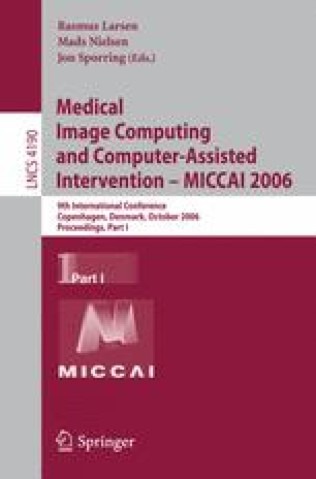
Medical Image Computing and Computer-Assisted Intervention – MICCAI 2006 ; Vol. 4190 ; 9th International Conference, Copenhagen, Denmark, October 1-6, 2006, Proceedings, Part I
MICCAI papers are of high standard and have a long lifetime. In this v- ume as well as in the latest journal issues of Medical Image Analysis and IEEE Transactions on Medical Imaging papers cite previous MICCAIs including the ?rst MICCAI conference in Cambridge, Massachusetts, 1998. It is obvious that the community requires the MICCAI papers as archive material. Therefore the proceedingsofMICCAIarefrom2005andhenceforthbeing indexedbyMedline. Acarefulreviewandselectionprocesswasexecutedinordertosecurethebest possible program for the MICCAI 2006 conference. We received 578 scienti?c papers from which 39 papers were selected for the oral program and 193 papers for the poster program.

Medical Image Computing and Computer-Assisted Intervention -- MICCAI 2005 ; 8th International Conference, Palm Springs, CA, USA, October 26-29, 2005, Proceedings, Part II
Robotics, Image-Guided Surgery and Interventions -- Image Registration II -- Medical Image Computing -- Atlases -- Shape I -- Structural and Functional Brain Analysis -- Model-Based Image Analysis -- Image-Guided Intervention: Simulation, Modeling and Display -- Simulation and Modeling II -- Medical Image Computing -- Shape II -- Image Segmentation and Analysis II -- Image Registration III --

Medical Image Computing and Computer-Assisted Intervention – MICCAI 2005 ; 8th International Conference, Palm Springs, CA, USA, October 26-29, 2005, Proceedings, Part I
This paper presents a method for classification of medical images, using machine learning and deformation-based morphometry. A morphological representation of the anatomy of interest is first obtained using highdimensional template warping, from which regions that display strong correlations between morphological measurements and the classification (clinical) variable are extracted using a watershed segmentation, taking into account the regional smoothness of the correlation map which is estimated by a crossvalidation strategy in order to achieve robustness to outliers. A Support Vector Machine-Recursive Feature Elimination (SVM-RFE) technique is then used to rank computed features from the extracted regions, according to their effect on the leave-one-out error bound. Finally, SVM classification is applied using the best set of features, and it is tested using leave-one-out. The results from a group of 61 brain images of female normal controls and schizophrenia patients demonstrate not only high classification accuracy (91.8%) and steep ROC curves, but also exceptional stability with respect to the number of selected features and the SVM kernel size
Medical data processing and analysis
Medical data can be defined as obtaining information from patients (such as signals, images, sounds, chemical components and their concentration, body temperature, respiratory rate, blood pressure, and different treatment measurements) to quantify the patient’s status and disease stage. Computer-aided diagnostic (CAD) systems use classical image processing, computer vision, machine learning, and deep learning methods for image analysis. Using image classification or segmentation algorithms, they find a region of interest (ROI) pointing to a specific location within the given image or an outcome of interest in the form of a label pointing to a diagnosis or prognosis. Computer science, with the evolution of artificial intelligence and machine learning techniques, facilitates the modeling and interpretation of results—from carrying out measurements to experiments and observations.

Medical centers management system
The medical clinics management system (MCMS) is a system that manages a group of clinics distributed within different governorates and regions in Syria, as it manages data entry processes for each patient such as personal information, disease and accompanying symptoms in addition to doctors' information, and clinics through a web application. The system also performs mining algorithms on the current data for discovering new symptoms and diseases by analyzing patient, diseases and symptoms data available within the database, to subsequently notify the admins of the emergence of a new symptom or an increase in a disease in a given area. In addition to generating daily or weekly reports containing the number of visits and cases of recovery and other information.
