



الصفحة 17
الصفحة 17

Foundation Website Creation with CSS, XHTML, and JavaScript
Foundation Website Creation with CSS, XHTML, and JavaScript covers the entire process of building a website. This process involves much more than just technical knowledge, and this book provides you with all the information you'll need to understand the concepts behind designing and developing for the Web, as well as the best means to deliver professional, best-practice-based results. There is far more to building a successful website than knowing a little Hypertext Markup Language (HTML). The process starts long before any coding takes place, and this book introduces you to the agile development process, explaining why this method makes so much sense for web projects and how best to implement it. Planning is vital, so you'll also learn how to use techniques such as brainstorming, wireframes, mockups, and prototypes to get your project off to the best possible start and help ensure smooth progress as it develops.
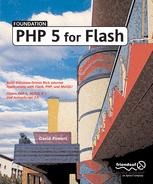
Foundation PHP5 for Flash
This latest, completely rewritten, edition again brings together three of the web's hottest technologies—Flash, the server-side language PHP, and the MySQL database system. We've brought things back up to date, using ActionScript 2.0, PHP 5.0, and MySQL 4.1, the book has been designed to be version-neutral. In other words, you can be confident that you're working with the latest standards, but that your applications won't break if deployed on an older server. The book also provides a brief introduction to an alternative database system, SQLite, which is now automatically bundled with PHP 5 and requires no installation.

Foundation Flash 8 Video
This book is the ultimate guide to Flash 8 video it offers practical advice, technical guidance, and a full series of creative projects ranging from the dead simple to the complex in a manner that talks to you as an equal and makes only one assumption: basic familiarity with the Flash interface. We start with the basicshow to edit video in some of the most popular packages available (such as iMovie and Movie Maker 2) and create a Flash video file and import it into Flash.

Foundation Expression Blend 2 : Building applications in WPF and silverlight
This book shows you how to take full advantage of Blend's interface, together with and Silverlight's vastly improved designer-developer workflow, guiding you through every step of development from downloading and installing of the development environment through creating finished, functional projects. You'll learn how to create simple drawing applications with the InkCanvas, make tabbed and scrollable interfaces, as well as build fully featured media players, photo galleries, and interactive 3D designs. Each chapter discusses major WPF and Silverlight features, provides a hands-on tutorial, and explains how that feature is implemented in the real world. In the end, you will have a collection of impressive WPF and Silverlight applications that can be added to your portfolio.

Foundation ActionScript 3.0 with Flash CS3 and Flex
If you want to create exciting dynamic web sites that will amaze your online audience, then the Flash platform is a great way to go, with it's many features, including powerful graphical and sound and video capabilities. To really harness the power of Flash though, you need to make use of ActionScript to provide dynamic effects, enable user interaction, and manipulate data. ActionScript 3.0, the Flash Platform's scripting language, offers a lot of new and powerful features. ActionScript is now a full-fledged programming language, with complete object-oriented capabilities, improved event handling, sound and video support, drawing capabilities, support for regular expressions, and much more. This book covers all the essential techniques from the ground up, allowing you to get up and running quickly and easily. Starting with the fundamentals, you'll learn about using ActionScript objects, manipulating sound and video, and harnessing the power of regular expressions and XML.

Foundation 3ds Max 8 Architectural Visualization
Welcome to the world of 3D architectural visualizations using the most powerful and versatile 3D software package on the planet: 3ds Max. In just the last few years, the visualization industry has arguably become the fastest-growing 3D industry, and may soon overtake all others in total number of users. Just as the use of computer-aided design became the norm for nearly all architectural, engineering, and construction firms in the 1990s, 3D visualizations have become standard practice today. This book takes you through the challenge of learning one of the most complex computer programs ever created, by way of easy-to-follow tutorials and instruction. It specifically focuses on those parts of the program you need to know to produce stunning architectural visualizations.

Formal Techniques for Networked and Distributed Systems - FORTE 2008 ; 28th IFIP WG 6.1 International Conference Tokyo, Japan, June 10-13, 2008 Proceedings
This book constitutes the refereed proceedings of the 28th IFIP WG 6.1 International Conference on Formal Techniques for Networked and Distributed Systems, FORTE 2008, held in Tokyo, Japan, in June 2008 co-located with TestCom/FATES 2008.The 19 revised full papers and 1 revised short paper presented together with 1 invited talk were carefully reviewed and selected from 44 submissions. The papers cover new approaches, concepts and experience in the application of formal methods for the specification and verification of distributed systems and applications.

Formal Techniques for Networked and Distributed Systems – FORTE 2007 ; 27th IFIP WG 6.1 International Conference, Tallinn, Estonia, June 27-29, 2007, Proceedings
These proceedings contain papers from the 27th FORTE conference. FORTE (Formal Techniques for Networked and Distributed Systems) is the joint int- national annual conference combining the former PSTV (Protocol Speci?cation Testing and Veri?cation) and former FORTE (Formal Description Techniques for Distributed Systems and Communication Protocols) conferences.
Formal techniques for networked and distributed systems - FORTE 2005 ; 25th IFIP WG 6.1 International Conference, Taipei, Taiwan, October 2-5, 2005, Proceedings
FORTE (Formal Techniques for Networked and Distributed Systems) 2005 was sp- sored by Working Group 6.1, Technical Committee 6 (TC6) of the International Fed- ation for InformationProcessing (IFIP).The conferenceseries started in 1981underthe name PSTV (ProtocolSpeci?cation, Testing, and Veri?cation).In 1988,a second series under the name FORTE was started. Both series merged to FORTE/PSTV in 1996. The conference name was changed to FORTE in 2001. During its 24-year history, many important contributions have been reported in the conference series. The last ?ve me- ings of FORTE were held in Pisa (Italy), Cheju Island (Korea), Houston (USA), Berlin (Germany), and Madrid (Spain). The 25th FORTE was held from Sunday to Wednesday, October 2–5, 2005 on the beautiful campus of the National Taiwan University (NTU), Taipei, Taiwan, ROC.

Formal techniques for computer systems and business processes ; European performance engineering workshop, EPEW 2005 and International workshop on web services and formal methods, WS-FM 2005, Versailles, France, September 1-3, 2005, Proceedings
This book constitutes the refereed proceedings of two colocated international workshops EPEW 2005 (European Performance Engineering Workshop) and WS-FM 2005 (Web Services and Formal Methods) held in Versailles, France in September 2005. The 20 revised full papers presented were carefully reviewed and selected from 59 submissions. For EPEW 2005 only 10 papers - of the 32 submitted - were accepted for presentation; they deal with queueing theory, bounding techniques, stochastic model checking, communication schemes analysis for high-speed LAN, QOS analysis in wireless ad-hoc networks and optical networks analysis. The main topics of the 10 papers accepted for WS-FM 2005 - from 27 submissions - include: protocols and standards for WS (SOAP, WSDL, UDDI, etc.); languages and description methodologies for Choreography/Orchestration/Workflow (BPML, XLANG and BizTalk, WSFL, WS-BPEL, etc.); coordination techniques for WS (transactions, agreement, coordination services, etc.); semantics-based dynamic WS discovery services (based on Semantic Web/Ontology Techniques or other semantic theories); security, performance evaluation and quality of service of WS; semi-structured data and XML related technologies; comparisons with different related technologies/approaches.

Formal Modeling and Analysis of Timed Systems ; Vol.4202 ; 4th International Conference, FORMATS 2006, Paris, France, September 25-27, 2006, Proceedings
The aim of FORMATS is to promote the study of fundamental and practical aspects of timed systems, and to bring together researchers from di?erent d- ciplines that share interests in modelling and analysis of timed systems. In this volume, there are articles on: – Foundations and Semantics: contributions to the theoretical foundations of timed systems and timed formal languages as well as comparison between di?erentmodelsusedbydi?erentcommunities(timedautomata,timedPetri nets, timed MSCs, hybrid automata, timed process algebra, timed temporal logics, timed abstract state machines, as well as probabilistic models). – Methods and Tools: techniques, algorithms, data structures, and software toolsforanalyzingtimedsystemsandresolvingtemporalconstraints(mod- checking, simulation, robustness analysis, scheduling, etc).

Formal Modeling and Analysis of Timed Systems ; Vol. 3829 ; 3rd International Conference, FORMATS 2005, Uppsala, Sweden, September 26-28, 2005, Proceedings
This book constitutes the thoroughly refereed post-proceedings of the Third International Conference on Formal Modeling and Analysis of Timed Systems, FORMATS 2005, held in Uppsala, Sweden in September 2005 in conjunction with ARTIST2 summer school on Component Modelling, Testing and Verification, and Static analysis of embedded systems. The 19 revised full papers presented together with the abstracts of 3 invited talks were carefully selected from 43 submissions. The papers cover work on semantics and modeling of timed systems, formalisms for modeling and verification including timed automata, hybrid automata, and timed petri nets, games for verification and synthesis, model-checking, case studies and issues related to implementation, security and performance analysis.

Formal Modeling and Analysis of Timed Systems ; 6th International Conference, FORMATS 2008, Saint Malo, France, September 15-17, 2008. Proceedings
This book constitutes the refereed proceedings of the 6th International Conference on Formal Modeling and Analysis of Timed Systems, FORMATS 2008, held in Saint Malo, France, September 2008.The 17 revised full papers presented together with 3 invited talks were carefully reviewed and selected from 37 submissions. The papers are organized in topical sections on extensions of timed automata and semantics; timed games and logic; case studies; model-checking of probabilistic systems; verification and test; timed petri nets.
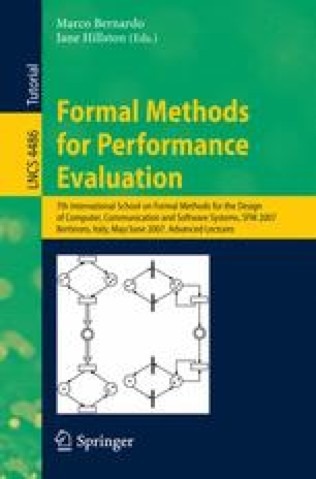
Formal Methods for Performance Evaluation ; 7th International School on Formal Methods for the Design of Computer, Communication, and Software Systems, SFM 2007, Bertinoro, Italy, May 8-June 2, 2007, Advanced Lectures
This book presents a set of 11 papers accompanying the lectures of leading researchers given at the 7th edition of the International School on Formal Methods for the Design of Computer, Communication and Software Systems, SFM 2007.

Formal Methods for Open Object-Based Distributed Systems ; Vol. 4037 ; 8th IFIP WG 6.1 International Conference, FMOODS 2006, Bologna, Italy, June 14-16, 2006, Proceedings
This book constitutes the refereed proceedings of the 8th IFIP WG 6.1 International Conference on Formal Methods for Open Object-Based Distributed Systems, FMOODS 2006, held in Bologna, Italy, June 2006. The book presents 16 revised full papers together with an invited paper and abstracts of 2 invited talks. Coverage includes component- and model-based design, service-oriented computing, software quality, modeling languages implementation, formal specification, verification, validation, testing, and service-oriented systems.

Formal Methods for Mobile Computing ; 5th International School on Formal Methods for the Design of Computer, Communication, and Software Systems, SFM-Moby 2005, Bertinoro, Italy, April 26-30, 2005, Advanced Lectures
This book presents 8 tutorial survey papers by leading researchers who lectured at the 5th International School on Formal Methods for the Design of Computer, Communication, and Software Systems, SFM 2005, held in Bertinoro, Italy in April 2005. SFM 2005 was devoted to formal methods and tools for the design of mobile systems and mobile communication infrastructures. The 8 lectures are organized into topical sections on models and languages, scalability and performance, dynamic power management, and middleware support.

Formal Methods for Hardware Verification ; 6th International School on Formal Methods for the Design of Computer, Communication, and Software Systems, SFM 2006, Bertinoro, Italy, May 22-27, 2006, Advances Lectures
This book presents 8 papers accompanying the lectures of leading researchers given at the 6th edition of the International School on Formal Methods for the Design of Computer, Communication and Software Systems (SFM 2006). SFM 2006 was devoted to formal techniques for hardware verification and covers several aspects of the hardware design process, including hardware design languages and simulation, property specification formalisms, automatic test pattern generation, symbolic trajectory evaluation, and more.

Formal Methods for Computational Systems Biology ; 8th International School on Formal Methods for the Design of Computer, Communication, and Software Systems, SFM 2008 Bertinoro, Italy, June 2-7, 2008 Advanced Lectures
This volume presents the set of papers accompanying the lectures of the eighth International School on Formal Methods for the Design of Computer, Com- nication, and Software Systems (SFM). This series of schools addresses the use of formal methods in computer science asaprominent approach to theri gorousdesign of computer, communication, and software systems. The main aim of the SFM series is to ofer a good spectrum of current research in foundations as well as applications of formal methods, which can be of help for graduate students and young researchers who intend to approach the feld.

Formal methods applications and technology ; 11th International workshop on formal methods for industrial critical systems, FMICS 2006, and 5th International Workshop on parallel and distributed methods in verification, PDMC 2006, Bonn, Germany, August 26-27, and August 31, 2006, Revised Selected
The workshop program included two invited talks, by Anna Slobodova from Intel on “Challenges for Formal Veri?cation in an Industrial Setting” and by Edward A. Lee from the University of California at Berkeley on “Making C- currency Mainstream.” The former full paper can be found in this volume.
Formal Methods and Software Engineering ; Vol. 3785 ; 7th International Conference on Formal Engineering Methods, ICFEM 2005, Manchester, UK, November 1-4, 2005, Proceedings
This volume contains papers presented at the 7th International Conference on Formal Engineering Methods (ICFEM 2005), 1-4 November 2005, Manchester, UK. Formal engineering methods are changing the way that systems are dev- oped. With language and tool support, these methods are being used for se- automatic code generation, and for the automatic abstraction and checking of implementations. In the future, they will be used at every stage of development: requirements, speci?cation, design, implementation, testing, anddocumentation. The aim of ICFEM 2005 was to bring together those interested in the - plication of formal engineering methods to computer systems. Researchers and practitioners, from industry, academia, and government, were encouraged to - tend, and to help advance the state of the art. The conference was supported by sponsorships from Microsoft Research, USA, the Software Engineers Association of Japan, the University of Man- ester, Manchester City Council, FormalMethods Europe (FME) and the British Computer Society FormalAspects ofComputing Specialist Group(BCS-FACS). We wish to thank these sponsors for their generosity. The ?nal programme consisted of 3 invited talks and 30 technical papers selected from a total of 74 submissions. The invited speakers were: Anthony Hall, independent consultant, UK; Egon B] orger, University of Pisa, Italy; John Rushby, SRI, USA. Their talks were sponsored by BCS-FACS, Microsoft - search and FME respectively. We wish to thank the invited speakers for their inspiring talks.
