



الصفحة 17
الصفحة 17

Autonomy oriented computing : From problem solving to complex systems modeling
Autonomy Oriented Computing explores the important theoretical and practical issues in AOC, by analyzing methodologies and presenting experimental case studies. The book serves as a comprehensive reference source for researchers, scientists, engineers, and professionals in all fields concerned with this promising new development in computer science. It can also be used as a main or supplementary text in graduate and undergraduate programs across a broad range of computer-related disciplines, including Robotics and Automation, Amorphous Computing, Image Processing and Computer Vision, Programming Paradigms, Computational Biology, and many others. The first part of the book, Fundamentals, describes the basic concepts and characteristics of an AOC system, and then it enumerates the critical design and engineering issues faced in AOC system development. The second part of the book, AOC in Depth, provides a detailed analysis of methodologies and case studies to evaluate the use of AOC in problem solving and complex system modeling. The final chapter reviews the essential features of the AOC paradigm and outlines a number of possibilities for future research and development.

Automated multi-camera surveillance : Algorithms and practice
This book discusses and proposes techniques for development of an automated multi-camera surveillance system for outdoor environments, while identifying the important issues that a system needs to cope with in realistic surveillance scenarios. The goal of the research presented in this book is to build systems that can deal effectively with these realistic surveillance needs.
Automated machine learning : Methods, systems, challenges
This book presents the first comprehensive overview of general methods in Automated Machine Learning (AutoML), collects descriptions of existing systems based on these methods, and discusses the first series of international challenges of AutoML systems. The recent success of commercial ML applications and the rapid growth of the field has created a high demand for off-the-shelf ML methods that can be used easily and without expert knowledge. However, many of the recent machine learning successes crucially rely on human experts, who manually select appropriate ML architectures (deep learning architectures or more traditional ML workflows) and their hyperparameters. To overcome this problem, the field of AutoML targets a progressive automation of machine learning, based on principles from optimization and machine learning itself.

Auralization : Fundamentals of acoustics, modelling, simulation, algorithms and acoustic virtual reality
"Auralization" is the technique of creation and reproduction of sound on the basis of computer data. With this tool is it possible to predict the character of sound signals which are generated at the source and modified by reinforcement, propagation and transmission in systems such as rooms, buildings, vehicles or other technical devices. This book is organized as a comprehensive collection of the basics of sound and vibration, acoustic modelling, simulation, signal processing and audio reproduction. Implementations of the auralization technique are described using examples drawn from various fields in acoustic’s research and engineering, architecture, sound design and virtual reality.

Artificial neural networks in Pattern Recognition ; 9th IAPR TC3 Workshop, ANNPR 2020, Winterthur, Switzerland, September 2–4, 2020, Proceedings
This book constitutes the refereed proceedings of the 9th IAPR TC3 International Workshop on Artificial Neural Networks in Pattern Recognition, ANNPR 2020, held in Winterthur, Switzerland, in September 2020. The conference was held virtually due to the COVID-19 pandemic. The 22 revised full papers presented were carefully reviewed and selected from 34 submissions. The papers present and discuss the latest research in all areas of neural network-and machine learning-based pattern recognition. They are organized in two sections: learning algorithms and architectures, and applications.

Artificial neural networks – ICANN 2007 ; 17th International Conference, Porto, Portugal, September 9-13, 2007, Proceedings, Part II
It features contributions related to computational neuroscience, neurocognitive studies, applications in biomedicine and bioinformatics, pattern recognition, self-organization, text mining and internet applications, signal and times series processing, vision and image processing, robotics, control, and more.

Artificial neural networks - ICANN 2006 ; Vol.4132 : 16th International Conference, Athens, Greece, September 10-14, 2006, Proceedings, Part II
This book includes the proceedings of the International Conference on Artificial Neural Networks (ICANN 2006) held on September 10-14, 2006 in Athens, Greece, with tutorials being presented on September 10, the main conference taking place during September 11-13 and accompanying workshops on perception, cognition and interaction held on September 14, 2006. The ICANN conference is organized annually by the European Neural Network Society in cooperation with the International Neural Network Society, the Japanese Neural Network Society and the IEEE Computational Intelligence Society. It is the premier European event covering all topics concerned with neural networks and related areas.

Artificial neural networks - ICANN 2006 ; Vol.4131 : 16th International Conference, Athens, Greece, September 10-14, 2006, Proceedings, Part I
This book includes the proceedings of the International Conference on Artificial Neural Networks (ICANN 2006) held on September 10-14, 2006 in Athens, Greece, with tutorials being presented on September 10, the main conference taking place during September 11-13 and accompanying workshops on perception, cognition and interaction held on September 14, 2006. The ICANN conference is organized annually by the European Neural Network Society in cooperation with the International Neural Network Society, the Japanese Neural Network Society and the IEEE Computational Intelligence Society. It is the premier European event covering all topics concerned with neural networks and related areas.

Artificial intelligence techniques for satellite image analysis
The main objective of this book is to provide a common platform for diverse concepts in satellite image processing. In particular it presents the state-of-the-art in Artificial Intelligence (AI) methodologies and shares findings that can be translated into real-time applications to benefit humankind. Interdisciplinary in its scope, the book will be of interest to both newcomers and experienced scientists working in the fields of satellite image processing, geo-engineering, remote sensing and Artificial Intelligence. It can be also used as a supplementary textbook for graduate students in various engineering branches related to image processing.

Artificial intelligence in medicine ; 11th Conference on artificial intelligence in medicine in Europe, AIME 2007, Amsterdam, The Netherlands, July 7-11, 2007, Proceedings
This book contains development of theory, systems, and applications of AI in medicine, including the exploitationof AI approachesto molecularmedicine and biomedical informatics.
Artificial intelligence in image-based screening, diagnostics, and clinical care of cardiopulmonary diseases
In this Special Issue, “Artificial Intelligence in Image-Based Screening, Diagnostics, and Clinical Care of Cardiopulmonary Diseases”, we have highlighted exemplary primary research studies and literature reviews focusing on novel AI/ML methods and their application in image-based screening, diagnosis, and clinical management of cardiopulmonary diseases.
Artificial intelligence for multisource geospatial information
Collects 10 original research contributions published in the Special Issue entitled “Artificial Intelligence for Multisource Geospatial Information” of the ISPRS International Journal of Geo-Information. The focus is on different methods of Geospatial Artificial Intelligence (GeoAI) based on deep learning using different network architectures, clustering, soft computing, and semantic approaches. They are proposed to deal with a variety of Geospatial Big Data (GBD), such as georeferenced texts and photos in social networks, remote sensing images, cartographic maps, multidimensional geo databases, metadata in spatial data infrastructures, and for different tasks, such as for multisource georeferenced text integration and geodata flexible querying, for social sensing by applying sentiment analysis, clustering and geo analysis, for segmentation of roads, clouds and snow, and for detection of small targets and people on the streets.

Artificial intelligence for multimedia signal processing
Artificial intelligence technologies are also actively applied to broadcasting and multimedia processing technologies. A lot of research has been conducted in a wide variety of fields, such as content creation, transmission, and security, and these attempts have been made in the past two to three years to improve image, video, speech, and other data compression efficiency in areas related to MPEG media processing technology. Additionally, technologies such as media creation, processing, editing, and creating scenarios are very important areas of research in multimedia processing and engineering. This book contains a collection of some topics broadly across advanced computational intelligence algorithms and technologies for emerging multimedia signal processing as: Computer vision field, speech/sound/text processing, and content analysis/information mining.
Artificial intelligence applied to medical imaging and computational biology
Medical imaging and computational biology continuously pose new fundamental medical and biological questions that often give rise to novel challenges in Artificial Intelligence. These research fields present an increasing need for the application of cutting-edge computational approaches that generally involve machine learning or computational intelligence techniques, which can effectively perform bioimage and biosignal processing in different clinical areas.
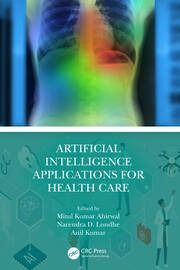
Artificial Intelligence Applications for Health Care
Covers topics on health care and artificial intelligence. Data sets related to biomedical signals (ECG, EEG, EMG) and images (X-rays, MRI, CT) are explored, analyzed, and processed through different computation intelligence methods. Applications of computational intelligence techniques like artificial and deep neural networks, swarm optimization, expert systems, decision support systems, clustering, and classification techniques on medial datasets are explained. Survey of medical signals, medial images, and computation intelligence methods are also provided.

Artificial intelligence applications and innovations ; 16th IFIP WG 12.5 International Conference, AIAI 2020, Neos Marmaras, Greece, June 5–7, 2020, Proceedings, Part I
This 2 volume-set of IFIP AICT 583 and 584 constitutes the refereed proceedings of the 16th IFIP WG 12.5 International Conference on Artificial Intelligence Applications and Innovations, AIAI 2020, held in Neos Marmaras, Greece, in June 2020.* The 70 full papers and 5 short papers presented were carefully reviewed and selected from 149 submissions. They cover a broad range of topics related to technical, legal, and ethical aspects of artificial intelligence systems and their applications

Artificial intelligence applications and innovations . AIAI 2020 IFIP WG 12.5 International Workshops ; MHDW 2020 and 5G-PINE 2020, Neos Marmaras, Greece, June 5–7, 2020, Proceedings
This book constitutes the refereed proceedings of two International Workshops held as parallel events of the 16th IFIP WG 12.5 International Conference on Artificial Intelligence Applications and Innovations, AIAI 2020, in Neos Marmaras, Greece, in June 2020: the 9th Mining Humanistic Data Workshop, MHDW 2020, and the 5th Workshop on 5G-Putting Intelligence to the Network Edge, 5G-PINE 2020.*

Artificial intelligence and soft computing ; 19th International conference, ICAISC 2020, Zakopane, Poland, October 12-14, 2020, Proceedings, Part II
The two-volume set LNCS 12415 and 12416 constitutes the refereed proceedings of of the 19th International Conference on Artificial Intelligence and Soft Computing, ICAISC 2020, held in Zakopane, Poland*, in October 2020. The 112 revised full papers presented were carefully reviewed and selected from 265 submissions. The papers included in the first volume are organized in the following six parts: neural networks and their applications; fuzzy systems and their applications; evolutionary algorithms and their applications; pattern classification; bioinformatics, biometrics and medical applications; artificial intelligence in modeling and simulation. The papers included in the second volume are organized in the following four parts: computer vision, image and speech analysis; data mining; various problems of artificial intelligence; agent systems, robotics and control.

Artificial intelligence and soft computing ; 19th International Conference, ICAISC 2020, Zakopane, Poland, October 12-14, 2020, Proceedings, Part I
The two-volume set LNCS 12415 and 12416 constitutes the refereed proceedings of of the 19th International Conference on Artificial Intelligence and Soft Computing, ICAISC 2020, held in Zakopane, Poland*, in October 2020. The 112 revised full papers presented were carefully reviewed and selected from 265 submissions. The papers included in the first volume are organized in the following six parts: neural networks and their applications; fuzzy systems and their applications; evolutionary algorithms and their applications; pattern classification; bioinformatics, biometrics and medical applications; artificial intelligence in modeling and simulation. The papers included in the second volume are organized in the following four parts: computer vision, image and speech analysis; data mining; various problems of artificial intelligence; agent systems, robotics and control.

Artificial intelligence and soft computing - ICAISC 2008 ; 9th International Conference Zakopane, Poland, June 22-26, 2008 Proceedings
This book constitutes the refereed proceedings of the 9th International Conference on Artificial Intelligence and Soft Computing, ICAISC 2008, held in Zakopane, Poland, in June 2008.
