



الصفحة 17
الصفحة 17

Formal Methods in Systems Biology ; 1st International Workshop, FMSB 2008, Cambridge, UK, June 4-5, 2008. Proceedings
This book constitutes the refereed proceedings of the First International Workshop on Formal Methods in Systems Biology, FMSB 2008, held in Cambridge, UK, in June, 2008.The 9 revised full papers presented were carefully reviewed and selected from the workshop lectures that all were invited contributions. The purpose of this meeting was to identify techniques for the specification, development and verification of biological models. It also focused on the design of tools to execute and analyze biological models that can significantly advance our understanding of biological systems.

Formal Methods for Open Object-Based Distributed Systems ; Vol. 4037 ; 8th IFIP WG 6.1 International Conference, FMOODS 2006, Bologna, Italy, June 14-16, 2006, Proceedings
This book constitutes the refereed proceedings of the 8th IFIP WG 6.1 International Conference on Formal Methods for Open Object-Based Distributed Systems, FMOODS 2006, held in Bologna, Italy, June 2006. The book presents 16 revised full papers together with an invited paper and abstracts of 2 invited talks. Coverage includes component- and model-based design, service-oriented computing, software quality, modeling languages implementation, formal specification, verification, validation, testing, and service-oriented systems.

Formal Methods for Open Object-Based Distributed Systems ; Vol. 3535 ; 7th IFIP WG 6.1 International Conference, FMOODS 2005, Athens, Greece, June 15-17, 2005, Proceedings
This volume contains the proceedings of FMOODS2005, the 7th IFIPWG6. 1 International Conference on Formal Methods for Open Object-Based Distributed Systems. The conference was held in Athens, Greece on June 15-17, 2005. The eventwasthe seventh meeting ofthis conference series, whichis held roughly every year and a half, with the earlier events held respectively in Paris, Canterbury, Florence, Stanford, Twente, and Paris. The goal of the FMOOD Sseries of conferences is to bring together researchers whose work encompasses three important and related fields: - formal methods; - distributed systems; - object-based technology. Sucha convergenceis representative of recent advances in the field of distributed systems, and provides links between several scientific and technological communities, as represented by the conferences FORTE, CONCUR, and ECOOP. The objective of FMOODS is to provide an integrated forum for the pres- tation of research in the above-mentioned fields, and the exchange of ideas and experiences in the topics concerned with the formal methods support for open object-based distributed systems.

Formal Methods for Open Object-Based Distributed Systems ; 9th IFIP WG 6.1 International Conference, FMOODS 2007, Paphos, Cyprus, June 6-8, 2007, Proceedings
This book constitutes the refereed proceedings of the 9th IFIP WG 6.1 International Conference on Formal Methods for Open Object-Based Distributed Systems, FMOODS 2007, held in Paphos, Cyprus in June 2007. The papers are organized in topcical sections on model checking rewriting logic components and services algebraic calculi specification, verification and refinenment, and quality of service.

Formal Methods for Open Object-Based Distributed Systems ; 10th IFIP WG 6.1 International Conference, FMOODS 2008, Oslo, Norway, June 4-6, 2008 Proceedings
This book constitutes the refereed proceedings of the 10th IFIP WG 6.1 International Conference on Formal Methods for Open Object-Based Distributed Systems, FMOODS 2008, held in Oslo, Norway, in June 2008.The 14 revised full papers presented together with 1 invited lecture were carefully reviewed and selected from 35 submissions. The papers cover topcics such as semantics of object-oriented programming; formal techniques for specification, analysis, and refinement; model checking; theorem proving and deductive verification.

Formal Methods for Mobile Computing ; 5th International School on Formal Methods for the Design of Computer, Communication, and Software Systems, SFM-Moby 2005, Bertinoro, Italy, April 26-30, 2005, Advanced Lectures
This book presents 8 tutorial survey papers by leading researchers who lectured at the 5th International School on Formal Methods for the Design of Computer, Communication, and Software Systems, SFM 2005, held in Bertinoro, Italy in April 2005. SFM 2005 was devoted to formal methods and tools for the design of mobile systems and mobile communication infrastructures. The 8 lectures are organized into topical sections on models and languages, scalability and performance, dynamic power management, and middleware support.

Formal Methods for Industrial Critical Systems ; 12th International Workshop, FMICS 2007, Berlin, Germany, July 1-2, 2007, Revised Selected Papers
This book constitutes the thoroughly refereed post-workshop proceedings of the 12th International Workshop on Formal Methods for Industrial Critical Systems, FMICS 2007, held in Berlin, Germany, in July 2007 - colocated with CAV 2007, the 19th International Conference on Computer Aided Verification.

Formal Methods for Computational Systems Biology ; 8th International School on Formal Methods for the Design of Computer, Communication, and Software Systems, SFM 2008 Bertinoro, Italy, June 2-7, 2008 Advanced Lectures
This volume presents the set of papers accompanying the lectures of the eighth International School on Formal Methods for the Design of Computer, Com- nication, and Software Systems (SFM). This series of schools addresses the use of formal methods in computer science asaprominent approach to theri gorousdesign of computer, communication, and software systems. The main aim of the SFM series is to ofer a good spectrum of current research in foundations as well as applications of formal methods, which can be of help for graduate students and young researchers who intend to approach the feld.
Formal Methods for Components and Objects ; Vol. 4111 ; 4th International Symposium, FMCO 2005, Amsterdam, The Netherlands, November 1-4, 2005, Revised Lectures
This book presents 19 revised invited keynote lectures and revised tutorial lectures given by top-researchers at the 4th International Symposium on Formal Methods for Components and Objects, FMCO 2005, held in Amsterdam, Netherlands, in November 2005. The book provides a unique combination of ideas on software engineering and formal methods that reflect the current interest in the application or development of formal methods for large scale software systems such as component-based systems and object systems.
Formal Methods for Components and Objects ; Vol. 3657 ; 3rd International Symposium, FMCO 2004, Leiden, The Netherlands, November 2-5, 2004, Revised Lectures
This book presents revised tutorial lectures given by invited speakers at the Third International Symposium on Formal Methods for Components and Objects, FMCO 2004, held in Leiden, The Netherlands, in November 2004. The 14 revised lectures by leading researchers present a comprehensive account of the potential of formal methods applied to large and complex software systems such as component-based systems and object systems. The book provides an unique combination of ideas on software engineering and formal methods that reflect the expanding body of knowledge on modern software systems.

Formal Methods for Components and Objects ; 6th International Symposium, FMCO 2007, Amsterdam, The Netherlands, October 24-26, 2007, Revised Lectures
Formal methods have been applied successfully to the verification of medium-sized programs in protocol and hardware design.This book presents 12 revised papers submitted after the symposium by the speakers of each of the following European IST projects: the IST-FP6 project Mobius, developing the technology for establishing trust and security for the next generation of global computers; the IST-FP6 project SelfMan on self management for large-scale distributed systems based on structured overlay networks and components
Formal Methods and Testing : An Outcome of the FORTEST Network, Revised Selected Papers
This book constitutes the thoroughly refereed and peer-reviewed outcome of the Formal Methods and Testing (FORTEST) network - formed as a network established under UK EPSRC funding that investigated the relationships between formal (and semi-formal) methods and software testing - now being a subject group of two BCS Special Interest Groups: Formal Aspects of Computing Science (BCS FACS) and Special Interest Group in Software Testing (BCS SIGIST).
Formal Methods and Hybrid Real-Time Systems : Essays in Honour of Dines Bjorner and Zhou Chaochen on the Occasion of Their 70th Birthdays
This paper presents a few of these, including a distributed garbage collection problem, distributed consensus problems for reconciling tree-like data structures, using model-based test case generation, and the use of software model checking in design and development process.

Formal aspects in security and trust ; Vol. 3866 ; 3rd International Workshop, FAST 2005, Newcastle upon Tyne, UK, July 18-19, 2005, Revised Selected Papers
This book constitutes the thoroughly refereed post-proceedings of the Third International Workshop on Formal Aspects in Security and Trust, FAST 2005, held in Newcastle upon Tyne, UK in July 2005. The papers focus on formal aspects in security and trust policy models, security protocol design and analysis, formal models of trust and reputation, logics for security and trust, distributed trust management systems, trust-based reasoning, digital assets protection, data protection, privacy and ID issues, information flow analysis, language-based security, security and trust aspects in ubiquitous computing, validation/analysis tools, web service security/trust/privacy, GRID security, security risk assessment, and case studies.

Formal approaches to software testing ; Vol. 3395 ; 4th International workshop, FATES 2004, Linz, Austria, September 21, 2004, Revised Selected Papers
Testing often accounts for more than 50% of the required e?ort during system development.Thechallengeforresearchistoreducethesecostsbyprovidingnew methods for the speci?cation and generation of high-quality tests. Experience has shown that the use of formal methods in testing represents a very important means for improving the testing process. Formal methods allow for the analysis andinterpretationofmodelsinarigorousandprecisemathematicalmanner.The use of formal methods is not restricted to system models only. Test models may alsobeexamined.Analyzingsystemmodelsprovidesthepossibilityofgenerating complete test suites in a systematic and possibly automated manner whereas examining test models allows for the detection of design errors in test suites and their optimization with respect to readability or compilation and execution time. Due to the numerous possibilities for their application, formal methods have become more and more popular in recent years. The Formal Approaches in Software Testing (FATES) workshop series also bene?ts from the growing popularity of formal methods. After the workshops in Aalborg (Denmark, 2001), Brno (Czech Republic, 2002) and Montr´ eal (Canada, 2003), FATES 2004 in Linz (Austria) was the fourth workshop of this series. Similar to the workshop in 2003, FATES 2004 was organized in a?liation with the IEEE/ACM Conference on Automated Software Engineering (ASE 2004). FATES 2004 received 41 submissions. Each submission was reviewed by at least three independent reviewers from the Program Committee with the help of some additional reviewers. Based on their evaluations, 14 full papers and one wo- in-progress paper from 11 di?erent countries were selected for presentation.

Formal Approaches to Agent-Based Systems ; 3rd International Workshop, FAABS 2004, Greenbelt, MD, April 26-27, 2004, Revised Selected Papers
The 3rd Workshop on Formal Approaches to Agent-Based Systems (FAABS-III) was held at the Greenbelt Marriott Hotel (near NASA Goddard Space Flight Center) in April 2004 in conjunction with the IEEE Computer Society. The first FAABS workshop was help in April 2000 and the second in October 2002. Interest in agent-based systems continues to grow and this is seen in the wide range of conferences and journals that are addressing the research in this area as well as the prototype and developmental systems that are coming into use. Our third workshop, FAABS-III, was held in April, 2004. This volume contains the revised papers and posters presented at that workshop. The Organizing Committee was fortunate in having significant support in the planning and organization of these events, and were privileged to have wor- renowned keynote speakers Prof. J Moore (FAABS-I), Prof. Sir Roger Penrose (FAABS-II), and Prof. John McCarthy (FAABS-III), who spoke on the topic of se- aware computing systems, auguring perhaps a greater interest in autonomic computing as part of future FAABS events. We are grateful to all who attended the workshop, presented papers or posters, and participated in panel sessions and both formal and informal discussions to make the workshop a great success. Our thanks go to the NASA Goddard Space Flight Center, Codes 588 and 581 (Software Engineering Laboratory) for their financial support and to the IEEE Computer Society (Technical Committee on Complexity in Computing) for their sponsorship and organizational assistance.

Forecasting Oracle Performance
Forecasting Oracle Performance is the first book to focus squarely on the problem of forecasting the future performance of an Oracle database. Other Oracle performance books are good for putting out fires; Craig's book helps you avoid all the heat in the first place.

Forecasting and Assessing Risk of Individual Electricity Peaks
The overarching aim of this open access book is to present self-contained theory and algorithms for investigation and prediction of electric demand peaks. A cross-section of popular demand forecasting algorithms from statistics, machine learning and mathematics is presented, followed by extreme value theory techniques with examples.

Food lens = فود لينس
Food lens is an innovative application designed to revolutionize dietary management by leveraging advanced image recognition and nutritional analysis. The primary objective of this senior project is to develop a user-friendly tool that identifies various foods through a camera interface and provides detailed nutritional information. This application not only enhances the user's understanding of their dietary intake but also assists in achieving personalized health and fitness goals. The core functionality of Food Lens involves the integration of a robust image recognition system capable of accurately identifying a wide range of foods. Upon identification, the application retrieves comprehensive nutritional data, including calorie content, macronutrient distribution (proteins, fats, carbohydrates), and essential micronutrients (vitamins and minerals). This data is then seamlessly integrated into the user's dietary profile. Food Lens is designed to track the user's daily caloric intake and compare it against personalized recommendations based on age, gender, weight, height, and activity level. By maintaining a dynamic record of consumed foods, the application provides real-time feedback on the user’s nutritional progress. This feature is particularly beneficial for individuals aiming to manage weight, address dietary restrictions, or improve overall health.
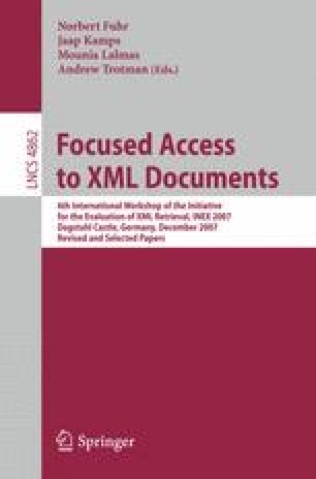
Focused Access to XML Documents ; 6th International Workshop of the Initiative for the Evaluation of XML Retrieval, INEX 2007 Dagstuhl Castle, Germany, December 17-19, 2007. Selected Papers
This book constitutes the thoroughly refereed post-conference proceedings of the 6th International Workshop of the Initiative for the Evaluation of XML Retrieval, INEX 2007, held at Dagstuhl Castle, Germany, in December 2007.The 37 revised full papers presented were carefully reviewed and selected for presentation at the workshop from 50 initial submissions. The papers are organized in an ad hoc track and 6 topical sections on book search, XML-mining, entity ranking, interactive, link-the-wiki, and multimedia.
