



الصفحة 17
الصفحة 17

Microsoft .NET framework 2.0 web-based client development : MCTS self-paced training Kit (Exam 70-528)
Designed to help you make the most of your study time. Maximize your performance on the exam by learning to: * Create, trace, configure, and deploy Web applications * Integrate data into your application using Microsoft ADO.NET, XML, and data-bound controls * Implement forms authentication, impersonation, and login controls * Configure server controls and create custom Web controls * Use themes, user profiles, and Web parts for customizable, personalized Web sites * Manage server-side and client-side application state PRACTICE TESTS Assess your skills with practice tests on CD. You can work through hundreds of questions using multiple testing modes to meet your specific learning needs. You get detailed explanations for right and wrong answers?including a customized learning path that describes how and where to focus your studies. Your kit includes: * Official self-paced study guide. * Practice tests with multiple, customizable testing options and a learning plan based on your results. *400+ practice and review questions. * Case scenarios and lab exercises. * Microsoft Visual Basic and Visual C# code samples on CD.

Microservices : Science and Engineering
This book describes in contributions by scientists and practitioners the development of scientific concepts, technologies, engineering techniques and tools for a service-based society. The focus is on microservices, i.e cohesive, independent processes deployed in isolation and equipped with dedicated memory persistence tools, which interact via messages.

Microprocessor 5 : Software and hardware aspects of development, debugging and testing - the microcomputer
Focuses more particularly on the first two generations of microprocessors, those that handle 4- and 8- bit integers. Microprocessor 5 – the fifth and final volume of this series of books – first presents the hardware and software aspects of the development chain of a microprocessor-based digital system. Finally, to round up the series and offer a historical perspective, the architectures of the first microcomputers are detailed. A comprehensive approach is used, with examples drawn from current and past technologies that illustrate theoretical concepts, making them accessible.

Microprocessor 4 : Core concepts - software aspects
Addresses the software aspects of this component. Coding of an instruction, addressing modes and the main features of the Instruction Set Architecture (ISA) of a generic component are presented. Futhermore, two approaches are discussed for altering the flow of execution using mechanisms of subprogram and interrupt. A comprehensive approach is used, with examples drawn from current and past technologies that illustrate theoretical concepts, making them accessible.

Microprocessor 3 : Core concepts - hardware aspects
Calculation is the main function of a computer. The central unit is responsible for executing the programs. The microprocessor is its integrated form. This component, since the announcement of its marketing in 1971, has not stopped breaking records in terms of computing power, price reduction and integration of functions (calculation of basic functions, storage with integrated controllers). It is present today in most electronic devices. Knowing its internal mechanisms and programming is essential for the electronics engineer and computer scientist to understand and master the operation of a computer and advanced concepts of programming.

Microprocessor 2 : Communication in a digital system
Focuses more particularly on the first generations of microprocessors, that is to say those that handle integers in 4 and 8-bit formats. The first chapter presents the calculation function and reminds the memory function. The following is devoted to notions of calculation model and architecture. The concept of bus is then presented. Chapters 4 and 5 can then address the internal organization and operation of the microprocessor first in hardware and then software. The mechanism of the function call, conventional and interrupted, is more particularly detailed in a separate chapter. The book ends with a presentation of architectures of the first microcomputers for a historical perspective. The knowledge is presented in the most exhaustive way possible with examples drawn from current and old technologies that illustrate and make accessible the theoretical concepts. Each chapter ends if necessary with corrected exercises and a bibliography. The list of acronyms used and an index are at the end of the book.

Microprocessor 1 : Prolegomena - calculation and storage functions - models of computation and computer architecture
Presents the computation function, recalls the memory function and clarifies the concepts of computational models and architecture. A comprehensive approach is used, with examples drawn from current and past technologies that illustrate theoretical concepts, making them accessible.

Micro-ISV : From Vision to Reality
Micro-ISV: From Vision to Reality explains what works and why in today's emerging micro-ISV sector. Currently, thousands of programmers build and deliver great solutions ISV-style, earning success and revenues much larger than you might guess. Written by and for micro-ISVs, with help from some of the leaders of the field, this book takes you beyond just daydreaming to running your own business. It thoroughly explores how it is indeed possible to launch and maintain a small and successful ISV business, and is an ideal read if you're interested in getting started.

Microformats : Empowering Your Markup for Web 2.0
This book is a comprehensive guide to microformats. It explores why—in Bill Gates' words—"We need microformats," how microformats work, and the kinds of problems microformats help solve. The book covers every current microformat, with complete details of the syntax, semantics, and uses of each, along with real-world examples and a comprehensive survey of the tools available for working with them. the book also features case studies detailing how major web content publishers such as yahoo put microformats to work in their web applications.

Microelectronic Circuits
Devices and basic circuits -- Signals, amplifiers and semiconductors -- Operational amplifiers -- Diodes -- Bipolar junction transistors (BJTS) -- Mos field-effect transistors (MOSFETS) -- Transistor amplifiers -- Analog integrated circuits -- Building blocks of integrated-circuit amplifiers -- Differential and multistage amplifiers -- Frequency response -- Feedback -- Output stages and power amplifiers -- Operational-amplifier circuits -- Filters and oscillators -- Digital integrated circuits -- CMOS digital logic circuits -- Digital Design: Power, Speed, and Area -- Memory and Clocking Circuits

The 8051 microcontroller and embedded systems
The Classical Period: Nineteenth Century Sociology Auguste Comte (1798-1857) on Women in Positivist Society Harriett Martineau (1802-1876) on American Women Bebel, August (1840-1913) on Women and Socialism Emile Durkheim (1858-1917) on the Division of Labor and Interests in Marriage Herbert Spencer (1820-1903) on the Rights and Status of Women Lester Frank Ward (1841-1913) on the Condition of Women Anna Julia Cooper (1858-1964) on the Voices of Women Thorstein Veblen (1857-1929) on Dress as Pecuniary Culture The Progressive Era: Early Twentieth Cent.

Micro-Assembly Technologies and Applications ; IFIP TC5 WG5.5 Fourth International Precision Assembly Seminar (IPAS’2008) Chamonix, France February 10–13, 2008
The IFIP series publishes state-of-the-art results in the sciences and technologies of information and communication. The scope of the series includes: foundations of computer science; software theory and practice; education; computer applications in technology; communication systems; systems modeling and optimization; information systems; computers and society; computer systems technology; security and protection in information processing systems; artificial intelligence; and human-computer interaction. Proceedings and post-proceedings of referred international conferences in computer science and interdisciplinary fields are featured. These results often precede journal publication and represent the most current research.

MICAI 2008 : Advances in Artificial Intelligence ;7th Mexican International Conference on Artificial Intelligence, Atizapán de Zaragoza, Mexico, October 27-31, 2008 Proceedings
The 96 revised full papers presented together with 2 invited lectures were carefully reviewed and selected from 363 submissions. The papers are organized in topical sections on logic and reasoning, knowledge-based systems, knowledge representation and acquisition, ontologies, natural language processing, machine learning, pattern recognition, data mining, neural networks, genetic algorithms, hybrid intelligent systems, computer vision and image processing, robotics, planning and scheduling, uncertainty and probabilistic reasoning, fuzzy logic, intelligent tutoring systems, multi-agent systems and distributed ai, intelligent organizations, bioinformatics and medical applications, as well as applications.

MICAI 2007 : Advances in artificial intelligence ; 6th Mexican International Conference on Artificial Intelligence, Aguascalientes, Mexico, November 4-10, 2007, Proceedings
The Mexican International Conference on Artificial Intelligence (MICAI), a yearly international conference series organized by the Mexican Society for Artificial Intelligence (SMIA), is a major international AI forum and the main event in the academic life of the country’s growing AI community.

MICAI 2006 : Advances in Artificial Intelligence ; 5th Mexican International Conference on Artificial Intelligence, Apizaco, Mexico, November 13-17, 2006, Proceedings
This volume contains the papers presented during the oral session of the 5 Mexican International Conference on Artificial Intelligence, held on November 13–17, 2006, at the Technologic Institute of Apizaco, Mexico. The conference received for evaluation 448 submissions by 1207 authors from 42 different countries
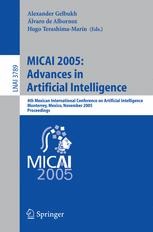
MICAI 2005 : Advances in Artificial Intelligence ; 4th Mexican International Conference on Artificial Intelligence, Monterrey, Mexico, November 14-18, 2005, Proceedings
Constitutes the refereed proceedings of the 4th Mexican International Conference on Artificial Intelligence, MICAI 2005, held Mexico, in November 2005. This book is organized in topical sections on knowledge representation and management, logic and constraint programming, uncertainty reasoning, multiagent systems and distributed AI, and others.

Methods and Tools for Collaborative Networked Organizations
Provides a comprehensive set of reference materials derived from the results of the ECOLEAD project in one organized volume. The ECOLEAD project, a large 4-year European initiative, involved 28 organizations (from academia, research and industry), from 14 countries (in Europe and Latin America).Three main types of results from ECOLEAD are presented: (i) Conceptual frameworks and models, (ii) Methods and processes, and (iii) Software tools and systems.

Methods and Procedures for the Verification and Validation of Artificial Neural Networks
Methods and Procedures for the Verification and Validation of Artificial Neural Networks is the culmination of the first steps in that research. This volume introduces some of the more promising methods and techniques used for the verification and validation (V&V) of neural networks and adaptive systems. A comprehensive guide to performing V&V on neural network systems, aligned with the IEEE Standard for Software Verification and Validation, will follow this book. The NASA IV&V and the Institute for Scientific Research, Inc. are working to be at the forefront of software safety and assurance for neural network and adaptive systems.

Methodological Investigations in Agent-Based Modelling : With Applications for the Social Sciences
Examines the methodological complications of using complexity science concepts within the social science domain. The opening chapters take the reader on a tour through the development of simulation methodologies in the fields of artificial life and population biology, then demonstrates the growing popularity and relevance of these methods in the social sciences. Following an in-depth analysis of the potential impact of these methods on social science and social theory, the text provides substantive examples of the application of agent-based models in the field of demography. This work offers a unique combination of applied simulation work and substantive, in-depth philosophical analysis, and as such has potential appeal for specialist social scientists, complex systems scientists, and philosophers of science interested in the methodology of simulation and the practice of interdisciplinary computing research.

Metalearning : Applications to Automated Machine Learning and Data Mining
This book as one of the fastest-growing areas of research in machine learning, metalearning studies principled methods to obtain efficient models and solutions by adapting machine learning and data mining processes. This adaptation usually exploits information from past experience on other tasks and the adaptive processes can involve machine learning approaches. As a related area to metalearning and a hot topic currently, automated machine learning (AutoML) is concerned with automating the machine learning processes. Metalearning and AutoML can help AI learn to control the application of different learning methods and acquire new solutions faster without unnecessary interventions from the user.
