



الصفحة 16
الصفحة 16

Knowledge Discovery from XML Documents ; 1st International Workshop, KDXD 2006, Singapore, April 9, 2006, Proceedings
The KDXD 2006 (Knowledge Discovery from XML Documents) workshop is the ?rst international workshop running this year in conjunction with the 10th Pacific-Asia Conference on Knowledge Discovery and Data Mining, PAKDD 2006. The workshop provided an important forum for the dissemination and exchange of new ideas and research related to XML data discovery and retrieval. The eXtensible Markup Language (XML) has become a standard language for data representation and exchange. With the continuous growth in XML data sources,the ability to manage collections of XML documents and discover knowledge from them for decision support becomes increasingly important. Due to the inherent ?exibility ofXML, in both structure and semantics, inferring important knowledge from XML data is faced with new challenges as well as bene?ts. The objective of the workshop was to bring together researchers and practitioners to discuss all aspects of the emerging XML data management challenges.

Knowledge and Skill Chains in Engineering and Manufacturing : Information Infrastructure in the Era of Global Communications
Explores knowledge and skill chains in engineering and manufacturing in the age of global communications. Information infrastructure involves a range of activities from product planning, engineering, and manufacturing trough transportation, marketing, and repair/upgrade to returns and recycling/disposal. Distinct from the traditional engineering database, life-cycle support information has its own characteristic requirements, -- flexible extensibility, distributed architecture, multiple viewpoints, long-time archiving, and product usage information. Several authors address the architecture of the information infrastructure, its services and its requirements. Other papers focus on the knowledge and skill chains that develop in a variety of situations: the supply chain, the factory floor, the man-system interaction, etc. For each of these, state-of-the-art and state-of-research scenarios for various industrial sectors address both engineering and operations requirements in the current socio-economic environment.
Knowledge and Data Management in GRIDs
Knowledge and Data Management in GRIDs is the third volume of the CoreGRID series and brings together scientific contributions by researchers and scientists working on storage, data, and knowledge management in GRID and Peer-to-Peer systems. This volume presents the latest GRID solutions and research results in key areas of knowledge and data management such as distributed storage management, GRID databases, Semantic GRID and GRID-aware data mining.
Journal on Data Semantics XI
The LNCS Journal on Data Semantics is devoted to the presentation of notable work that, in one way or another, addresses research and development on issues related to data semantics. The scope of the journal ranges from theories supporting the formal definition of semantic content to innovative domain-specific applications of semantic knowledge. The journal addresses researchers and advanced practitioners working on the semantic web, interoperability, mobile information services, data warehousing, knowledge representation and reasoning, conceptual database modeling, ontologies, and artificial intelligence.
Journal on Data Semantics X
Web semantics and semi-structured data , Semantic caching , Data warehousing and semantic data mining , Spatial, temporal, multimedia and multimodal semantics , Semantics in data visualization , Semantic services for mobile users , Supporting tools , Applications of semantic-driven approaches These topics are to be understood as specifically related to semantic issues. Contributions submitted to the journal and dealing with semantics of data will be considered even if they are not from the topics in the list. While the physical appearance of the journal issues is like the books from the we- known Springer LNCS series, the mode of operation is that of a journal. Contributions can be freely submitted by authors and are reviewed by the Editorial Board.
Journal on Data Semantics VIII
Springer's LNCS Journal on Data Semantics aims at providing a highly visible dissemination channel for most remarkable work that in one way or another addresses research and development on issues related to the semantics of data. The target domain ranges from theories supporting the formal definition of semantic content to innovative domain-specific application of semantic knowledge. This publication channel should be of the highest interest to researchers and advanced practitioners working on the Semantic Web, interoperability, mobile information services, data warehousing, knowledge representation and reasoning, conceptual database modeling, ontologies, and artificial intelligence.
Journal on Data Semantics VII
The LNCS Journal on Data Semantics is devoted to the presentation of notable work that, in one way or another, addresses research and development on issues related to data semantics. Based on the highly visible publication platform Lecture Notes in Computer Science, this new journal is widely disseminated and available worldwide. The scope of the journal ranges from theories supporting the formal definition of semantic content to innovative domain-specific applications of semantic knowledge. The journal addresses researchers and advanced practitioners working on the semantic web, interoperability, mobile information services, data warehousing, knowledge representation and reasoning, conceptual database modeling, ontologies, and artificial intelligence.
Journal on Data Semantics V
The LNCS Journal on Data Semantics is devoted to the presentation of notable work that, in one way or another, addresses research and development on issues related to data semantics. Based on the highly visible publication platform Lecture Notes in Computer Science, this new journal is widely disseminated and available worldwide. The scope of the journal ranges from theories supporting the formal definition of semantic content to innovative domain-specific applications of semantic knowledge. The journal addresses researchers and advanced practitioners working on the semantic web, interoperability, mobile information services, data warehousing, knowledge representation and reasoning, conceptual database modeling, ontologies, and artificial intelligence.
Journal on Data Semantics IX
The LNCS Journal on Data Semantics is devoted to the presentation of notable work that, in one way or another, addresses research and development on issues related to data semantics. The scope of the journal ranges from theories supporting the formal definition of semantic content to innovative domain-specific applications of semantic knowledge.
Journal on Data Semantics IV
• Semantics in data visualization • Semantic services for mobile users • Supporting tools • Applications of semantic-driven approaches These topics are to be understood as specifically related to semantic issues. Contributions submitted to the journal and dealing with semantics of data will be considered even if they are not within the topics in the list. While the physical appearance of the journal issues is like the books from the we- known Springer LNCS series, the mode of operation is that of a journal. Contributions can be freely submitted by authors and are reviewed by the Editorial Board. Contributions may also be invited, and nevertheless carefully reviewed, as in the case for issues that contain extended versions of the best papers from major conferences addressing data semantics issues. Special issues, focusing on a specific topic, are coordinated by guest editors once the proposal for a special issue is accepted by the Editorial Board. Finally, it is also possible that a journal issue be devoted to a single text.
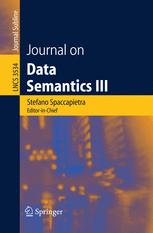
Journal on Data Semantics III
– semantic caching – data warehousing and semantic data mining – spatial, temporal, multimedia and multimodal semantics – semantics in data visualization – semantic services for mobile users – supporting tools – applications of semantic-driven approaches These topics are to be understood as speci?cally related to semantic issues. Contributions submitted to the journal and dealing with semantics of data will be considered even if they are not within the topics in the list. While the physical appearance of the journal issues looks like the books from the well-known Springer LNCS series, the mode of operation is that of a journal. Contributions can be freely submitted by authors and are reviewed by the Editorial Board. Contributions may also be invited, and nevertheless carefully reviewed, as in the case for issues that contain extended versions of best papers from major conferences addressing data semantics issues. Special issues, focusing on a speci?c topic, are coordinated by guest editors once the proposal for a special issue is accepted by the Editorial Board. Finally, it is also possible that a journal issue be devoted to a single text.
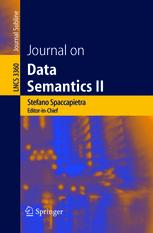
Journal on Data Semantics II
The LNCS Journal on Data Semantics is devoted to the presentation of notable work that, in one way or another, addresses research and development on issues related to data semantics. Based on the highly visible publication platform Lecture Notes in Computer Science, this new journal is widely disseminated and available worldwide. The scope of the journal ranges from theories supporting the formal definition of semantic content to innovative domain-specific applications of semantic knowledge. The journal addresses researchers and advanced practitioners working on the semantic web, interoperability, mobile information services, data warehousing, knowledge representation and reasoning, conceptual database modeling, ontologies, and artificial intelligence.
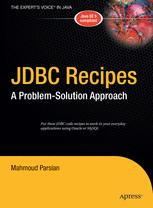
JDBC Recipes : A Problem-Solution Approach
JDBC Recipes provides easy-to-implement, usable solutions to problems in relational databases that use JDBC. You will be able to integrate these solutions into your web-based applications, such as Java servlets, JavaServer Pages, and Java server-side frameworks. This handy book allows you to cut and paste the solutions without any code changes. This book focuses on topics that have been ignored in most other JDBC books, such as database and result set metadata. It will help you develop database solutions, like adapters, connectors, and frameworks using Java/JDBC. The insightful solutions will enable you to handle all data types, including large binary objects. A unique feature of the book is that it presents JDBC solutions (result sets) in XML.
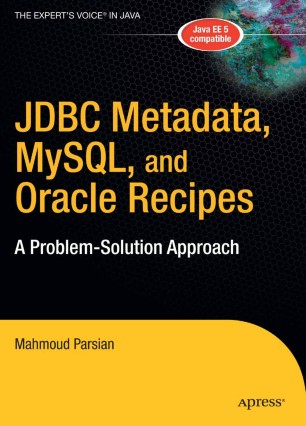
JDBC Metadata, MySQL, and Oracle Recipes : A Problem-Solution Approach
JDBC Metadata, MySQL, and Oracle Recipes is the only book that focuses on metadata or annotation-based code recipes for JDBC API for use with Oracle and MySQL. It continues where the authors other book, JDBC Recipes: A Problem-Solution Approach, leaves off. This edition is also a Java EE 5-compliant book, perfect for lightweight Java database development. And it provides cut-and-paste code templates that can be immediately customized and applied in each developer's application development.

Java : how to program. Late objects : Introducing Jshell
Introduction to Computers, the Internet and Java / Introduction to Java Applications; Input/Output and Operators / Control Statements: Part 1; Assignment, ++ and Operators / Control Statements: Part 2; Logical Operators / Methods / Arrays and ArrayLists / Introduction to Classes and Objects / Classes and Objects: A Deeper Look / Object-Oriented Programming: Inheritance / Object-Oriented Programming: Polymorphism and Interfaces / Exception Handling: A Deeper Look / JavaFX Graphical User Interfaces / JavaFX GUI / Strings, Characters and Regular Expressions / Files, Input/Output Streams, NIO and XML Serialization / Generic Collections / Lambdas and Streams / Recursion / Searching, Sorting and Big O / Generic Classes and Methods: A Deeper Look / Custom Generic Data Structures / JavaFX Graphics and Multimedia / Concurrency / Accessing Databases with JDBC / Introduction to JShell: Java 9's REPL for Interactive Java

Comparative genomics ; Vol. 3388 : RECOMB 2004 International Workshop, RCG 2004, Bertinoro, Italy, October 16-19, 2004, Revised Selected Papers
This papers investigates the problem of conservation of combinatorial structures in genome rearrangement scenarios. We give a characterization of a class of scenarios that conserve all common intervals, called commuting scenarios, and a characterization of permutations for which commuting scenarios exist. We show that measuring conservation of common intervals can be useful tool in assessing the quality of rearrangement scenarios, by investigating in detail three specific scenarios involving the mouse, rat and human X chromosomes.

Citation Analysis in Research Evaluation
This book is written for members of the scholarly research community, and for persons involved in research evaluation and research policy. More specifically, it is directed towards the following four main groups of readers: – All scientists and scholars who have been or will be subjected to a quantitative assessment of research performance using citation analysis. – Research policy makers and managers who wish to become conversant with the basic features of citation analysis, and about its potentialities and limitations. – Members of peer review committees and other evaluators, who consider the use of citation analysis as a tool in their assessments. – Practitioners and students in the field of quantitative science and technology studies, informetrics, and library and information science. Citation analysis involves the construction and application of a series of indicators of the ‘impact’, ‘influence’ or ‘quality’ of scholarly work, derived from citation data, i.e. data on references cited in footnotes or bibliographies of scholarly research publications. Such indicators are applied both in the study of scholarly communication and in the assessment of research performance. The term ‘scholarly’ comprises all domains of science and scholarship, including not only those fields that are normally denoted as science – the natural and life sciences, mathematical and technical sciences – but also social sciences and humanities.

Chinese Computational Linguistics ; 19th China National Conference, CCL 2020, Hainan, China, October 30 – November 1, 2020, Proceedings
This book constitutes the proceedings of the 19th China National Conference on Computational Linguistics, CCL 2020, held in Hainan, China, in October/November 2020. The 32 full and 2 short papers presented in this volume were carefully reviewed and selected from 99 submissions. They were organized in topical sections named: fundamental theory and methods of computational linguistics; information retrieval, dialogue and question answering; text generation and summarization; knowledge graph and information extraction; machine translation and multilingual information processing; minority language information processing; language resource and evaluation; social computing and sentiment analysis; and NLP applications.

Challenges of expanding internet : E-commerce, e-business, and e-government ; 5th IFIP conference on e-commerce, e-business, and e-government (I3E'2005), October 28-30 2005, Poznan, Poland
This book constitutes the refereed proceedings of the5th IFIP Conference e-Commerce, e-Business, and e-Government (I3E’2005), 2005, Poznan, Poland This collection of papers offers Topics e-Commerce/e-business Sales/Distribution / Information Systems Applications (incl. Internet) / Computer Communication Networks / Cryptology / Database Managemen

Cellular Automata and Discrete Complex Systems ; 26th IFIP WG 1.5 International Workshop, AUTOMATA 2020, Stockholm, Sweden, August 10–12, 2020, Proceedings
This volume constitutes the refereed post-conference proceedings of the 26th IFIP WG 1.5 International Workshop on Cellular Automata and Discrete Complex Systems, AUTOMATA 2020, held in Stockholm, Sweden, in August 2020. The workshop was held virtually. The 11 full papers presented in this book were carefully reviewed and selected from a total of 21 submissions. The topics of the conference include dynamical, topological, ergodic and algebraic aspects of CA and DCS, algorithmic and complexity issues, emergent properties, formal languages, symbolic dynamics, tilings, models of parallelism and distributed systems, timing schemes, synchronous versus asynchronous models, phenomenological descriptions, scientific modeling, and practical applications.
