



الصفحة 16
الصفحة 16
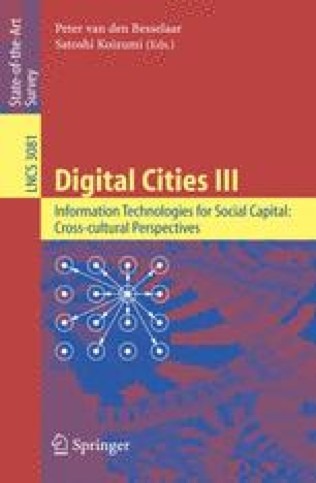
Digital cities III : Information technologies for social capital: Cross-cultural Perspectives ; 3rd international digital cities workshop, Amsterdam, The Netherlands, September 18-19, 2003, Revised Selected Papers
Digital cities constitutes a multidisciplinary field of research and development, where researchers, designers and developers of communityware interact and collaborate with social scientists studying the use and effects of these kinds of infrastructures and systems in their local application context. The field is rather young. After the diffusion of ICT in the world of organizations and companies, ICT entered everyday life. And this also influenced ICT research and development. The 1998 Workshop on Communityware and Social Interaction in Kyoto was an early meeting in which this emerging field was discussed.

Deterministic and statistical methods in Machine Learning ; 1st International Workshop, Sheffield, UK, September 7-10, 2004. Revised Lectures
This book consitutes the refereed proceedings of the First International Workshop on Machine Learning held in Sheffield, UK, in September 2004. The 19 revised full papers presented were carefully reviewed and selected for inclusion in the book. They address all current issues in the rapidly maturing field of machine learning that aims to provide practical methods for data discovery, categorisation and modelling. The particular focus of the workshop was advanced research methods in machine learning and statistical signal processing.

Dependable Systems : Software, Computing, Networks : Research Results of the DICS Program
The present volume documents the results of a research program on Dependable Information and Communication Systems (DICS). The members of the project met in two workshops organized by the Hasler Foundation. This state-of-the-art survey contains 3 overview articles identifying major issues of dependability and presenting the latest solutions, as well as 10 carefully selected and revised papers depicting the research results originating from those workshops. The first workshop took place in Münchenwiler, Switzerland, in March 2004, and the second workshop, which marked the conclusion of the projects, in Löwenberg, Switzerland, in October 2005. The papers are organized in topical sections on surveys, dependable software, dependable computing, and dependable networks.

Dependable and adaptable networks and services ; 13th Open European Summer School and IFIP TC6.6 Workshop, EUNICE 2007, Enschede, The Netherlands, July 18-20, 2007, Proceedings
Innovative Internet Applications.’ Much has changed since then: wireless network technologies have become a constantly growing part of the Internet infrastructure, and increasingly smaller and more powerful computing devices with ?exible connectivity open the possibility of new services and applications.

Deontic Logic and Artificial Normative Systems ; 8th International Workshop on Deontic Logic in Computer Science, DEON 2006, Utrecht, The Netherlands, July 12-14, 2006, Proceedings
This volume presents the papers contributed to DEON 2006, the 8th Inter- tional Workshop on Deontic Logic in Computer Science, held in Utrecht, The Netherlands, July 12–14, 2006. These biennial DEON (more properly, ?EON) workshops are designed to promote international cooperation among scholars across disciplines who are interested in deontic logic and its use in computer science.

Defence Applications of Multi-Agent Systems; International Workshop, DAMAS 2005, Utrecht, The Netherlands, July 25, 2005, Revised and Invited Papers
This book constitutes the thoroughly refereed post-proceedings of the International Workshop on Defence Applications of Multi-Agent Systems, DAMAS 2005, held in Utrecht, The Netherlands in July 2005 as an associated event of AAMAS 2005, the main international conference on autonomous agents and multi-agent systems. The 10 revised full papers presented together with 1 invited article are organized in topical sections on decision support and simulation, unmanned aerial vehicles, as well as on systems and security.

Deep structure, singularities, and computer vision ; 1st international workshop, DSSCV 2005, Maastricht, The Netherlands, June 9-10, 2005, revised selected papers
Constitutes the refereed post-proceedings of the First International Workshop on Deep Structure, Singularities, and Computer Vision, DSSCV 2005, held in Maastricht. This book represents in understanding the relation between structural, topological information represented by singularities and metric information of signals, shapes, and colors.
Declarative agent languages and technologiesV ; 5th International Workshop, DALT 2007, Honolulu, HI, USA, May 14, 2007, Revised Selected and Invited Papers
This book constitutes the thoroughly refereed post-workshop proceedings of the 5th International Workshop on Declarative Agent Languages and Technologies, DALT 2007, held in Honolulu, USA, in 2007.
Declarative agent languages and technologies IV ; 4th International Workshop, DALT 2006, Hakodate, Japan, May 8, 2006, Selected, Revised and Invited Papers
Constitutes the thoroughly refereed post-proceedings of the 4th International Workshop on Declarative Agent Languages and Technologies, DALT 2006, held in Japan in May 2006. This was an associated event of AAMAS 2006, the main international conference on autonomous agents and multi-agent systems. The 12 revised full papers presented together with one invited talk and three invited papers were carefully selected for inclusion in the book.

Declarative agent languages and technologies III ; 3rd International Workshop, DALT 2005, Utrecht, The Netherlands, July 25, 2005, Selected and Revised Papers
The workshop on Declarative Agent Languages and Technologies is a we- established venue for researchers interested in sharing their experiences in the areas of declarative and formal aspects of agents and multi-agent systems, and in engineering and technology. Today it is still a challenge to develop techno- gies that can satisfy the requirements of complex agent systems. The design and development of multi-agent systems still calls for models and technologies that ensure predictability, enable feature discovery, allow for the veri?cation of properties, and guarantee ?exibility. Declarative approaches are potentially a valuable means for satisfying the needs of multi-agent system developers and for specifying multi-agent systems.
Declarative agent languages and technologies II ; 2nd international workshop, DALT 2004, New York, NY, USA, July 19, 2004, revised selected papers
Nearly 40 research groups worldwide were motivated to contribute to this event by submitting their most recent research achievements, covering a wide variety of the topics listed in the call for papers. More than 30 top researchers agreed to join the Program Committee, which then collectively faced the hard task of selecting the one-day event program. The fact that research in multi-agent systems is no longer only a novel and promising research horizon at dawn is, in our opinion, the main reason behind DALT’s (still short) success story. On the one hand, agent theories and app- cations are mature enough to model complex domains and scenarios, and to successfully address a wide range of multifaceted problems, thus creating the urge to make the best use of this expressive and versatile paradigm, and also pro?t from all the important results achieved so far. On the other hand, bui- ing multi-agent systems still calls for models and technologies that could ensure system predictability, accommodate ?exibility, heterogeneity and openness, and enable system veri?cation.
Databases, Information Systems, and Peer-to-Peer Computing ; International Workshops, DBISP2P 2005/2006, Trondheim, Norway, August 28-29, 2006, Revised Selected Papers
The P2P paradigm lends itself to constructing large-scale, complex, adaptive, autonomous and heterogeneous database and information systems, endowed with clearly specified and difierential capabilities to negotiate, bargain, coordinate and self-organize the information exchanges in large-scale networks. This vision will have a radical impact on the structure of complex organizations (business, sci- tific or otherwise) and on the emergence and the formation of social communities, and on how the information is organized and processed. The P2P information paradigm naturally encompasses static and wireless connectivity and static and mobile architectures. Wireless connectivity combined with the increasingly small and powerful mobile devices and sensors poses new challenges as well as opp- tunities to the database community. Information becomes ubiquitous, highly distributed and accessible anywhere and at any time over highly dynamic, - stable networks with very severe constraints on the information management and processing capabilities.

Databases, information systems, and peer-to-peer computing ; 2nd international workshop, DBISP2P 2004, Toronto, Canada, August 29-30, 2004, revised selected papers
Peer-to-peer (P2P) paradigm lends itself to constructing large-scale complex, adaptive, - tonomous and heterogeneous database and information systems, endowed with clearly speci?ed and di?erential capabilities to negotiate, bargain, coordinate, and self-organize the information exchanges in large-scale networks. This vision will have a radical impact on the structure of complex organizations (business, scienti?c, or otherwise) and on the emergence and the formation of social c- munities, and on how the information is organized and processed. The P2P information paradigm naturally encompasses static and wireless connectivity, and static and mobile architectures. Wireless connectivity c- bined with the increasingly small and powerful mobile devices and sensors pose new challenges to as well as opportunities for the database community. Inf- mation becomes ubiquitous, highly distributed and accessible anywhere and at any time over highly dynamic, unstable networks with very severe constraints on the information management and processing capabilities.

Databases in networked information systems; 4th international workshop, DNIS 2005, Aizu-Wakamatsu, Japan, March 28-30, 2005, Proceedings
This book constitutes the refereed proceedings of the 4th International Workshop on Databases in Networked Information Systems, DNIS 2005, held in Aizu-Wakamatsu, Japan in March 2005. The 17 revised full papers presented together with 8 invited papers were carefully reviewed and selected for inclusion in the book. The papers are organized in topical sections on information interchange and management systems, Web data management systems, networked information systems applications, and networked information systems implementations.
Databases in Networked Information Systems ; 5th International Workshop, DNIS 2007, Aizu-Wakamatsu, Japan, October 17-19, 2007, Proceedings
This book Is focusing on data semantics and infrastructure for information management and interchange, the papers are organized in topical sections on geospatial decision-making, Web data management systems, infrastructure of networked information systems, and Web query and web mining systems.

Database Schema Evolution and Meta-Modeling ; 9th International Workshop on Foundations of Models and Languages for Data and Objects FoMLaDO/DEMM 2000 Dagstuhl Castle, Germany, September 18-21, 2000 Selected Papers
The Ninth International Workshop on Foundations of Models and Languages for Data and Objects (FoMLaDO) took place in Dagstuhl Germany, Sept- ber 18{21, 2000. The topic of this workshop was Database schema Evolution and Meta-Modeling; this FoMLaDO Workshop was hence assigned the acronym DEMM 2000.

Database Programming Languages ; 8th International Workshop, DBPL 2001, Frascati, Italy, September 8-10, 2001. Revised Papers
The papers here are organized in topical sections on semistructured data OL AP and data mining systems, schema integration, and index concurrency XML spatial databases user languages and rules.

Database Programming Languages ; 10th international symposium, DBPL 2005, Trondheim, Norway, August 28-29, 2005, revised selected papers
Constitutes the refereed post-proceedings of the 10th International Workshop on Database Programming Languages, DBPL 2005. This book presents papers organized in topical sections on XML languages, XML and P2P data integration, XML query languages, types and XML, grammars, automata, and tree, as well as dependencies and constraints.

Database and expert systems applications ; DEXA 2020 International workshops BIOKDD, IWCFS and MLKgraphs, Bratislava, Slovakia, September 14–17, 2020, Proceedings
This volume constitutes the refereed proceedings of the three workshops held at the 31st International Conference on Database and Expert Systems Applications, DEXA 2020, held in September 2020: The 11th International Workshop on Biological Knowledge Discovery from Data, BIOKDD 2020, the 4th International Workshop on Cyber-Security and Functional Safety in Cyber-Physical Systems, IWCFS 2020, the 2nd International Workshop on Machine Learning and Knowledge Graphs, MLKgraphs2019. Due to the COVID-19 pandemic the conference and workshop were held virtually. The 10 papers were thoroughly reviewed and selected from 15 submissions, and discuss a range of topics including: knowledge discovery, biological data, cyber security, cyber-physical system, machine learning, knowledge graphs, information retriever, data base, and artificial intelligent.

Database and expert systems applications ; 16th international conference, DEXA 2005, Copenhagen, Denmark, August 22-26, 2005, Proceedings
DEXA 2005, the 16th International Conference on Database and Expert Systems Applications, was held at the Copenhagen Business School, Copenhagen, Denmark, from August 22 to 26, 2005. The success of the DEXA series has partly been due to the way in which it has kept abreast of recent developments by spawning specialized workshops and conferences each with its own proceedings. In 2005 the DEXA programme was co-located with the 7th International Conference on Data Warehousing and Knowledge Discovery [DaWaK 2005], the 6th International Conference on Electronic Commerce and Web Technologies [EC-Web 2005], the 4th International Conference on Electronic Government [EGOV 2005], the 2nd International Conference on Trust, Privacy, and Security in Digital Business [TrustBus 2005], the 2nd International Conference on Industrial Applications of Holonic and Multi-agent Systems [HoloMAS 2005], as well as 19 specialized workshops. These proceedings are the result of a considerable amount of hard work.
