



الصفحة 14
الصفحة 14

Graph Transformation ; 13th International Conference, ICGT 2020, Held as Part of STAF 2020, Bergen, Norway, June 25–26, 2020, Proceedings
This book constitutes the refereed proceedings of the 13th International Conference on Graph Transformation, ICGT 2020, in Bergen, Norway, in June 2020.* The 16 research papers and 4 tool paper presented in this book were carefully reviewed and selected from 40 submissions. One invited paper is also included. The papers deal with the following topics: theoretical advances; application domains; and tool presentations.

Graph structures for knowledge representation and reasoning ; 6th International Workshop, GKR 2020, virtual event, September 5, 2020, revised selected papers
This book constitutes the thoroughly refereed post-conference proceedings of the 6th International Workshop on Graph Structures for Knowledge Representation and Reasoning, GKR 2020, held virtually in September 2020, associated with ECAI 2020, the 24th European Conference on Artificial Intelligence.

Grammatical Picture Generation : A Tree-Based Approach
The book presents important types of picture generators, using a tree-based approach to stress their common algorithmic basis, the treatment influenced by the theory of computation, and the theory of formal languages in particular. It guides the reader through the basics of the tree-based approach on to dedicated chapters on line-drawing languages, collage grammars, iterated function systems, grid picture languages, languages of fractals, and languages of coloured collages, while presenting results about (un)decidable, NP-complete, or efficiently solvable problems, normal forms, hierarchies of language classes, and related phenomena.

Google Maps Mashups with Google Mapplets
Have a Google Maps mashup that you'd like to expose to millions of users on maps.google.com? New to the mapping craze, but have an idea for a killer map–based application? Want to learn how to create GeoRSS and KML feeds with your geotagged content, exposing your customer to new ways of exploring and navigating your content? Google Maps Mashups with Google Mapplets Is the first book to cover Google's Mapplet technology Shows you how to create Google Maps–based applications and publish to maps.google.com Provides a single–source resource and practical guide to Mapplets and mashups Teaches you how to mash up Mapplets using location–specific data

Gesture in Human-Computer Interaction and Simulation ; 6th International Gesture Workshop, GW 2005, Berder Island, France, May 18-20, 2005, Revised Selected Papers
The international Gesture Workshops have become the leading interdisciplinary events for dissemination of the latest results on gesture-based communication. The goal of these workshops is to bring together researchers who want to meet and share ideas on advanced research on gesture related to multidisciplinary scienti?c ?elds. Depending on the ?elds, the objectives can be very di?erent. While physiology and biomechanics aim to extract fundamental knowledge of physical gesture, computer sciences try to capture di?erent aspects of gesture and extract features that help to identify, interpret or rebuild the underlying mechanisms of communication gestures. Other approaches and methodologies are followed by cognitive sciences and linguistics, bringing a complementary - derstanding of motor control and gesture meaning. The results can be enhanced by technological applications or demonstrations.

GeoSpatial semantics ; 2nd International Conference, GeoS 2007, Mexico City, Mexico, November 29-30, 2007
This paper reports a simple case study of extracting the two types of such hierarchies from formal texts of traffic code. Problems of concurrent use of both hierarchies for ontology reasoning are dis-cussed, particularly, in context of the different views on geospatial ontologies.
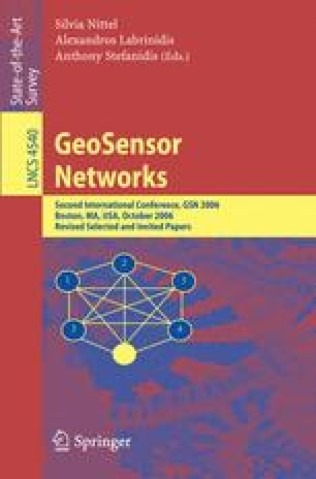
GeoSensor Networks : 2nd International Conference, GSN 2006, Boston, MA, USA, October 1-3, 2006, Revised Selected and Invited Papers
This book constitutes the thoroughly refereed proceedings of the Second GeoSensor Networks Conference, held in Boston, Massachusetts, USA, in October 2006. The conference addressed issues related to the collection, management, processing, analysis, and delivery of real-time geospatial data using distributed geosensor networks. This represents an evolution of the traditional static and centralized geocomputational paradigm.

Geographic Information Science ; 5th International Conference, GIScience 2008, Park City, UT, USA, September 23-26, 2008. Proceedings
This book constitutes the refereed proceedings of the 5th International Conference on Geographic Information Secience, GIScience 2008, held in Park City, UT, USA, in September 2008.The 24 revised full papers presented were carefully reviewed and selected from 77 submissions. Among the traditional topics addressed are spatial relations, geographic dynamics, and spatial data types. A significant number of papers deal with navigation networks, location-based services, and spatial information query and retrieval. Geo-sensors, mobile computing, and Web mapping rank among the important new directions.

Generative programming and component engineering ; 4th International conference, GPCE 2005, Tallinn, Estonia, September 29 - October 1, 2005, Proceedings
Generative Programming and Component Engineering (GPCE) is a leading - searchconferenceonautomaticprogrammingandcomponentengineering.These approaches to software engineering have the potential to revolutionize software development as automation and components revolutionized manufacturing. The conference brings together researchers and practitioners interested in adva- ing automation for software development. It is also a premier forum for cro- fertilization between the programming language and software engineering - search communities. GPCEaroseasajointconference, mergingthepriorconferenceonGenerative and Component-Based Software Engineering (GCSE) and the Workshop on - mantics, Applications, andImplementationofProgramGeneration(SAIG). The proceedingsofthepreviousGPCEconferenceswerepublishedintheLNCSseries of Springer as volumes2487,2830, and 3286.In 2005 GPCE wasco-locatedwith the International Conference on Functional Programming (ICFP) and the s- posium on Trends in Functional Programming (TFP), re?ecting the vigorous interaction between the functional programming and generative programming research communities. GPCE and ICFP are both sponsored by the Association for Computing Machinery. The quality and breadth of the papers submitted to GPCE 2005 was impr- sive. All 86 papers, including 5 papers for tool demonstrations, were rigorously reviewed by 17 highly quali?ed Program Committee members. The members of the Program Committee ?rst provided in-depth individual reviews of the s- mitted papers, and then debated the merits of the papers through an extended electronicProgramCommitteemeeting.After much(friendly) argument,25r- ular papers and 2 tool demonstration papers were selected for publication. The ProgramCommittee provided extensive technical feedback to the authors of the submittedpapers.Theconferenceprogramwascomplementedwiththreeinvited talks, three extended tutorials, and three all-day workshops.

Fuzzy-Neuro Approach to Agent Applications : From the AI Perspective to Modern Ontology
The book provides a full explanation of the concepts and theories of intelligent agents and agent-based systems. Providing a comprehensive theoretical background, the author covers modern artificial intelligence topics such as ontologies, neural networks, chaos theory, fuzzy logics and genetic algorithms. Finally, the author details how the iJADK toolkit (intelligent Java agent development kit for intelligent e-business applications) can be used in the design and implementation phases of real applications.

Fuzzy systems and knowledge discovery ; Vol. 3614 ; 2nd International Conference, FSKD 2005, Changsha, China, August 27-29, 2005, Proceedings, Part II
This book and its sister volume, LNAI 3613 and 3614, constitute the proce- ings of the Second International Conference on Fuzzy Systems and Knowledge Discovery (FSKD 2005), jointly held with the First International Conference on Natural Computation (ICNC 2005, LNCS 3610, 3611, and 3612) from - gust 27–29, 2005 in Changsha, Hunan, China. FSKD 2005 successfully attracted 1249 submissions from 32 countries/regions (the joint ICNC-FSKD 2005 received 3136 submissions). After rigorous reviews, 333 high-quality papers, i. e. , 206 long papers and 127 short papers, were included in the FSKD 2005 proceedings, r- resenting an acceptance rate of 26. 7%. The ICNC-FSKD 2005 conference featured the most up-to-date research - sults in computational algorithms inspired from nature, including biological, e- logical, and physical systems. It is an exciting and emerging interdisciplinary area in which a wide range of techniques and methods are being studied for dealing with large, complex, and dynamic problems. The joint conferences also promoted cross-fertilization over these exciting and yet closely-related areas, which had a signi?cant impact on the advancement of these important technologies. Speci?c areas included computation with words, fuzzy computation, granular com- tation, neural computation, quantum computation, evolutionary computation, DNA computation, chemical computation, information processing in cells and tissues, molecular computation, arti?cial life, swarm intelligence, ants colony, arti?cial immune systems, etc. , with innovative applications to knowledge d- covery, ?nance, operations research, and more.

Fuzzy systems and knowledge discovery ; Vol. 3613 ; 2nd International Conference, FSKD 2005, Changsha, China, August 27-29, 2005, Proceedings, Part I
This book and its sister volume, LNAI 3613 and 3614, constitute the proce- ings of the Second International Conference on Fuzzy Systems and Knowledge Discovery (FSKD 2005), jointly held with the First International Conference on Natural Computation (ICNC 2005, LNCS 3610, 3611, and 3612) from - gust 27–29, 2005 in Changsha, Hunan, China. FSKD 2005 successfully attracted 1249 submissions from 32 countries/regions (the joint ICNC-FSKD 2005 received 3136 submissions). After rigorous reviews, 333 high-quality papers, i. e. , 206 long papers and 127 short papers, were included in the FSKD 2005 proceedings, r- resenting an acceptance rate of 26. 7%. The ICNC-FSKD 2005 conference featured the most up-to-date research - sults in computational algorithms inspired from nature, including biological, e- logical, and physical systems. It is an exciting and emerging interdisciplinary area in which a wide range of techniques and methods are being studied for dealing with large, complex, and dynamic problems. The joint conferences also promoted cross-fertilization over these exciting and yet closely-related areas, which had a signi?cant impact on the advancement of these important technologies. Speci?c areas included computation with words, fuzzy computation, granular com- tation, neural computation, quantum computation, evolutionary computation, DNA computation, chemical computation, information processing in cells and tissues, molecular computation, arti?cial life, swarm intelligence, ants colony, arti?cial immune systems, etc. , with innovative applications to knowledge d- covery, ?nance, operations research, and more.

Fuzzy Logic, Identification and Predictive Control
Fuzzy Logic, Identification and Predictive Control is a comprehensive introduction to the use of fuzzy methods in many different control paradigms encompassing robust, model-based, PID-like and predictive control. This combination of fuzzy control theory and industrial serviceability will make a telling contribution to your research whether in the academic or industrial sphere and also serves as a fine roundup of the fuzzy control area for the graduate student

Fuzzy Logic with engineering applications
Latest advances in the field including material on expansion of the MLFE method using genetic algorithms, cognitive mapping, fuzzy agent-based models and total uncertainty. Redundant or obsolete topics have been removed, resulting in a more concise yet inclusive text that will ensure the book retains its broad appeal at the forefront of the literature.

Fuzzy database modeling with XML
Fuzzy Database Modeling with XML aims to provide a single record of current research and practical applications in the fuzzy databases. This volume is the outgrowth of research the author has conducted in recent years. Fuzzy Database Modeling with XML introduces state of the art information to the database research, while at the same time serving the information technology professional faced with a non-traditional application that defeats conventional approaches. The research on fuzzy conceptual models and fuzzy object-oriented databases is receiving increasing attention, in addition to fuzzy relational database models. With rapid advances in network and internet techniques as well, the databases have been applied under the environment of distributed information systems. It is essential in this case to integrate multiple fuzzy database systems. Since databases are commonly employed to store and manipulate XML data, additional requirements are necessary to model fuzzy information with XML. Second, this book maps fuzzy XML model to the fuzzy databases. Very few efforts at investigating these issues have thus far occurred.

Future data and security engineering : Big data, security and privacy, smart city and industry 4.0 applications ; 7th International Conference, FDSE 2020, Quy Nhon, Vietnam, November 25–27, 2020, Proceedings
This book constitutes the proceedings of the 7th International Conference on Future Data and Security Engineering, FDSE 2020, held in Quy Nhon, Vietnam, in November 2020.* The 29 full papers and 8 short were carefully reviewed and selected from 161 submissions. The selected papers are organized into the following topical headings: big data analytics and distributed systems; security and privacy engineering; industry 4.0 and smart city: data analytics and security; data analytics and healthcare systems; machine learning-based big data processing; emerging data management systems and applications; and short papers: security and data engineering.

Funology : From usability to enjoyment
This book reflects the move in Human Computer Interaction studies from standard usability concerns towards a wider set of problems to do with fun, enjoyment, aesthetics and the experience of use. Traditionally HCI has been concerned with work and task based applications but as digital technologies proliferate in the home fun becomes an important issue. There is an established body of knowledge and a range of techniques and methods for making products and interfaces usable, but far less is known about how to make them enjoyable.

Fundamentals of image data mining : Analysis, features, classification and retrieval
Presents a comprehensive review of the essentials of image data mining, and the latest cutting-edge techniques used in the field. The coverage spans all aspects of image analysis and understanding, offering deep insights into areas of feature extraction, machine learning, and image retrieval. The theoretical coverage is supported by practical mathematical models and algorithms, utilizing data from real-world examples and experiments. Topics and features: Describes essential tools for image mining, covering Fourier transforms, Gabor filters, and contemporary wavelet transforms / Develops many new exercises (most with MATLAB code and instructions) / Includes review summaries at the end of each chapter / Analyses state-of-the-art models, algorithms, and procedures for image mining / Integrates new sections on pre-processing, discrete cosine transform, and statistical inference and testing / Demonstrates how features like color, texture, and shape can be mined or extracted for image representation / Applies powerful classification approaches: Bayesian classification, support vector machines, neural / networks, and decision trees / Implements imaging techniques for indexing, ranking, and presentation, as well as database visualization

Fundamentals of Clinical Data Science
This book comprehensively covers the fundamentals of clinical data science, focusing on data collection, modelling and clinical applications. Topics covered in the first section on data collection include: data sources, data at scale (big data), data stewardship (FAIR data) and related privacy concerns. Aspects of predictive modelling using techniques such as classification, regression or clustering, and prediction model validation will be covered in the second section. The third section covers aspects of (mobile) clinical decision support systems, operational excellence and value-based healthcare.

Fundamentals of Algebraic Graph Transformation
Graphs are widely used to represent structural information in the form of objects and connections between them. Graph transformation is the rule-based manipulation of graphs, an increasingly important concept in computer science and related fields. This is the first textbook treatment of the algebraic approach to graph transformation, based on algebraic structures and category theory.
