



الصفحة 13
الصفحة 13

Conceptual Modeling of Information Systems
When designing an information system, conceptual modeling is the activity that elicits and describes the general knowledge the system needs to know. This description, called the conceptual schema, is necessary in order to develop an information system.textbook explains in detail the principles of conceptual modeling independently from particular methods and languages and shows how to apply them in real-world projects. It covers all aspects of the engineering process from structural modeling over behavioral modeling to meta-modeling, and completes the presentation with an extensive case study based on the osCommerce system, an online store-management software program freely available under the GNU General Public License. His presentation is based on well-known industry standards like UML and OCL as a particular conceptual modeling language, yet also delivers the basics of the formal logical language background.

Conceptual Modeling for Traditional and Spatio-Temporal Applications : The MADS Approach
This book shows that a conceptual design approach for spatio-temporal databases is both feasible and easy to apprehend. While providing a firm basis through extensive discussion of traditional data modeling concepts, the major focus of the book is on modeling spatial and temporal information. Parent, Spaccapietra and Zimányi provide a detailed and comprehensive description of an approach that fills the gap between application conceptual requirements and system capabilities, covering both data modeling and data manipulation features.

Conceptual Modeling for New Information Systems Technologies ; ER 2001 Workshops, HUMACS, DASWIS, ECOMO, and DAMA, Yokohama Japan, November 27-30, 2001. Revised Papers
The objective of the workshops associated with ER 2001, the 20th International Con- rence on Conceptual Modeling, was to give participants the opportunity to present and discuss emerging hot topics, thus adding new perspectives to conceptual modeling.
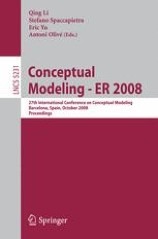
Conceptual Modeling - ER 2008 ; 27th International Conference on Conceptual Modeling, Barcelona, Spain, October 20-24, 2008. Proceedings
This book constitutes the refereed proceedings of the 27th International Conference on Conceptual Modeling, ER 2008, held in Barcelona, Spain, in October 2008.

Conceptual Modeling - ER 2007 ; 26th International Conference on Conceptual Modeling, Auckland, New Zealand, November 5-9, 2007, Proceedings
Conceptual modeling is fundamental to the development of complex systems, because it provides the key communication means between systems developers, end-users and customers.Conceptua lmodeling provides languages,methods and tools to understand and represent the application domain;to elicitate,concepalize and formalize system requirements and user needs;to communicate systems designs to all stakeholders; to formally verify and validate system designs on high levels of abstractions; and to minimize ambiguities in system development. Initially, conceptual modeling mainly addressed data-intensive information s- tems and contributed to data modeling and database application engineering. The area of conceptual modeling has now matured to encompass all kinds of application areas such as e-applications (including e-business and e-learning), web-based systems (including the semantic web and ubiquitous systems), life science and geographic applications.

Conceptual Modeling - ER 2005
Conceptual modeling is fundamental to any domain where one must cope with complex real-world situations and systems because it fosters communication - tween technology experts and those who would bene?t from the application of those technologies. Conceptual modeling is the key mechanism for und- standing and representing the domains of information system and database - gineering but also increasingly for other domains including the new “virtual” e-environmentsandtheinformationsystemsthatsupportthem.Theimportance of conceptual modeling in software engineering is evidenced by recent interest in “model-drivenarchitecture”and“extremenon-programming”.Conceptualm- eling also plays a prominent rolein various technical disciplines and in the social sciences. The Annual International Conference on Conceptual Modeling (referred to as the ER Conference) provides a central forum for presenting and discussing current research and applications in which conceptual modeling is the major emphasis.

Computers Helping People with Special Needs ; 11th International Conference, ICCHP 2008, Linz, Austria, July 9-11, 2008. Proceedings
This book constitutes the refereed proceedings of the 11th International Conference on Computers Helping People with Special Needs, ICCHP 2008, held in Linz, Austria in July 2008.

Computer-Human Interaction ; 8th Asia-Pacific Conference, APCHI 2008 Seoul, Korea, July 6-9, 2008 Proceedings
This book constitutes the refereed proceedings of the 8th Asia Pacific Conference on Computer Human Interaction, APCHI 2008, held in Seoul, Korea, in July 2008.

Computer Supported Cooperative Work in Design IV ; 11th International Conference, CSCWD 2007, Melbourne, Australia, April 26-28, 2007. Revised Selected Papers
This book constitutes the thoroughly refereed post-conference proceedings of the 11th International Conference on Computer Supported Cooperative Work in Design, CSCWD 2007, held in Melbourne, Australia, in April 2007.

Computer Security - ESORICS 2008 ; 13th European Symposium on Research in Computer Security, Málaga, Spain, October 6-8, 2008. Proceedings
This book constitutes the refereed proceedings of the 13th European Symposium on Research in Computer Security, ESORICS 2008, held in Torremolinos, Spain, in October 2008.

Computer Music Modeling and Retrieval. Sense of Sounds ; 4th International Symposium, CMMR 2007, Copenhagen, Denmark, August 27-31, 2007. Revised Papers
This book constitutes the thoroughly refereed post-conference proceedings of the 4th International Computer Music Modeling and Retrieval Symposium, CMMR 2007, held in Copenhagen, Denmark, in August 2007 jointly with the International Computer Music Conference 2007, ICMC 2007.

Computer Music Modeling and Retrieval ; Vol. 3310
This volume contains the final proceedings for the 2004 Computer Music Model-ing and Retrieval Symposium (CMMR 2004). CMMR is an annualevent focusing on important aspects of computer music. CMMR 2004 is the sec-ond event in this series. The use of computers in music is well established. CMMR 2004 provided aunique opportunity to meet and interact with peers concerned with the cross-influence of the technological and creative in computer music. The field of com-puter music is interdisciplinary by nature and closely related to a number of com-puter science and engineering areas such as information retrieval, programming,human computer interaction, digital libraries, hypermedia, artificial intelligence,acoustics, signal processing, etc. The event gathered many interesting people(researchers, educators, composers, performers, and others). There were manyhigh-quality keynote and paper presentations, that fostered inspiring discussions.

Computer Aided Verification ; 32nd International Conference, CAV 2020, Los Angeles, CA, USA, July 21–24, 2020, Proceedings, Part I
The two-volume set LNCS 12224 and 12225 constitutes the refereed proceedings of the 32st International Conference on Computer Aided Verification, CAV 2020, held in Los Angeles, CA, USA, in July 2020.*

Computer Aided Systems Theory – EUROCAST 2005 ; 10th International Conference on Computer Aided Systems Theory, Las Palmas de Gran Canaria, Spain, February 7-11, 2005, Revised Selected Papers
The concept of CAST, computer aided systems Theory, was introduced by F. Pichler of Linz in the late 1980s to include those computer theoretical and practical developments used as tools to solve problems in system science. It was considered as the third component (the other two being CAD and CAM) that would provide for a complete picture of the path from computer and systems sciences to practical developments in science and engineering. Selected papers were published as Springer Lecture Notes in Computer Science vols. 410, 585, 763, 1030, 1333, 1728, 2178 and 2809 and in several special issues of Cybernetics and Systems: an lnternational

Computational Science and Its Applications - ICCSA 2008 ; International Conference, Perugia, Italy, June 30– July 3, 2008, Proceedings, Part II
The two-volume set LNCS 5072 and 5073 constitutes the refereed proceedings of the International Conference on Computational Science and Its Applications, ICCSA 2008, held in Perugia, Italy in June/July 2008.

Computational science and its applications - ICCSA 2008 ; International Conference, Perugia, Italy, June 30 – July 3, 2008, Proceedings, Part I
The two-volume set LNCS 5072 and 5073 constitutes the refereed proceedings of the International Conference on Computational Science and Its Applications, ICCSA 2008, held in Perugia, Italy, in June/July, 2008.

Computational science and its applications - ICCSA 2005 ; International Conference, Singapore, May 9-12, 2005, Proceedings, Part II
The four volume set assembled following The 2005 International Conference on Computational Science and its Applications, ICCSA 2005, held in Suntec International Convention and Exhibition Centre, Singapore, from 9 May 2005 till 12 May 2005, represents the ?ne collection of 540 refereed papers selected from nearly 2,700 submissions. Computational Science has ?rmly established itself as a vital part of many scienti?c investigations, a?ecting researchers and practitioners in areas ranging from applications such as aerospace and automotive, to emerging technologies such as bioinformatics and nanotechnologies, to core disciplines such as ma- ematics, physics, and chemistry. Due to the shear size of many challenges in computational science, the use of supercomputing, parallel processing, and - phisticated algorithms is inevitable and becomes a part of fundamental t- oretical research as well as endeavors in emerging ?elds.

Computational Science - ICCS 2008 ; 8th International Conference, Kraków, Poland, June 23-25, 2008, Proceedings, Part III
The three-volume set LNCS 5101-5103 constitutes the refereed proceedings of the 8th International Conference on Computational Science, ICCS 2008, held in Krakow, Poland in June 2008.

Computational Science - ICCS 2008 ; 8th International Conference, Kraków, Poland, June 23-25, 2008, Proceedings, Part II
The three-volume set LNCS 5101-5103 constitutes the refereed proceedings of the 8th International Conference on Computational Science, ICCS 2008, held in Krakow, Poland in June 2008.
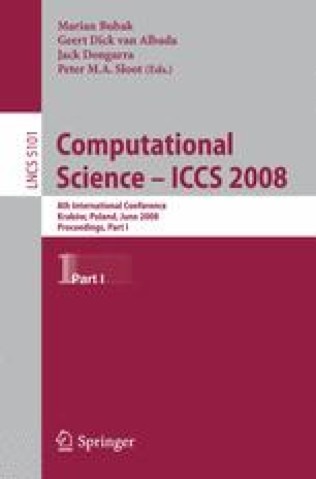
Computational Science - ICCS 2008 ; 8th International Conference, Kraków, Poland, June 23-25, 2008, Proceedings, Part I
The three-volume set LNCS 5101-5103 constitutes the refereed proceedings of the 8th International Conference on Computational Science, ICCS 2008, held in Krakow, Poland in June 2008.
