



الصفحة 13
الصفحة 13
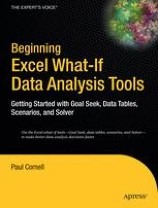
Beginning Excel What-If Data Analysis tools : Getting started with goal seek, data tables, scenarios, and solver
Excels what-if data analysis tools let you experiment with your data to project future results. In turn, these predictions will lead to better decision making and unlock the mystery of many business analysis scenarios. For example, what-if data analysis tools will enable you to forecast how lowering the price per unitwhile increasing projected unit salesmight affect your profit margins. Beginning Excel What-If Data Analysis Tools explores the use of Goal Seek, Data Tables, Scenarios, and Solver to help you get insight on your data. This book is focused and to the point, and it provides tutorial treatment of what-if tools in a practical, hands-on manner.
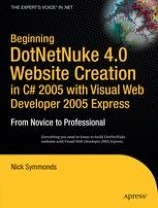
Beginning DotNetNuke 4.0 Website Creation in C# 2005 with Visual Web Developer 2005 Express : From novice to professional
The book takes you through the steps necessary to get an internal web portal running for employee use. If you have some programming experience and creativity, this book will help you expand your business presence in a short amount of time. It features simple explanations and proof-of-concept examples throughout. The book concludes with the creation of a web portlet that you can plug into an external website for a web presence.
Beginning deep learning with TensorFlow : Work with Keras, MNIST data sets, and advanced neural networks
Stats with an introduction to AI, where you’ll learn the history of neural networks and what sets deep learning apart from other varieties of machine learning. Discovery the variety of deep learning frameworks and set-up a deep learning development environment. Next, you’ll jump into simple classification programs for hand-writing analysis. Once you’ve tackled the basics of deep learning, you move on to TensorFlow 2 specifically. Find out what exactly a Tensor is and how to work with MNIST datasets. Finally, you’ll get into the heavy lifting of programming neural networks and working with a wide variety of neural network types such as GANs and RNNs. Deep Learning is a new area of Machine Learning research widely used in popular applications, such as voice assistant and self-driving cars. Work through the hands-on material in this book and become a TensorFlow programmer! You will: Develop using deep learning algorithms Build deep learning models using TensorFlow 2 Create classification systems and other, practical deep learning applications
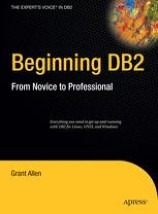
Beginning DB2 : From novice to professional
IBM’s DB2 Express Edition is one of the most capable of the free database platforms available in today’s marketplace. In Beginning DB2, author Grant Allen gets you started using DB2 Express Edition for web sites, desktop applications, and more. The author covers the basics of DB2 for developers and database administrators, shows you how to manage data in both XML and relational form, and includes numerous code examples so that you are never in doubt as to how things work.
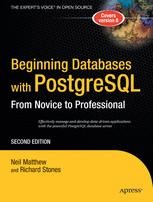
Beginning Databases with PostgreSQL : From novice to professional
The book continues with a complete tutorial on PostgreSQL features and functions and include information on database construction and administration. Key features such as transactions, stored procedures and triggers are covered, along with many of the capabilities new to version 8. To help you get started quickly, step-by-step instructions on installing PostgreSQL on Windows and Linux/UNIX systems are included. In the remainder of the book, we show you how to make the most of PostgreSQL features in your own applications using a wide range of programming languages, including C, Perl, PHP, Java and C#. Many example programs are presented in the book, and all are available for download from the Apress web site. By the end of the book you will be able to install, use, and effectively manage a PostgreSQL server, design and implement a database, and create and deploy your own database applications.
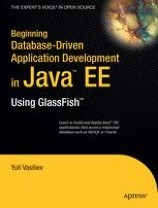
Beginning Database-Driven Application Development in Java EE : Using GlassFish™
The book explains in detail how you can organize your Java EE solution into a multilayer architecture, placing most emphasis on how to implement the persistence and database tiers of an application. Through many examples, this book shows how you can efficiently use the Java Persistence features available in the Java EE platform. Find out how you can greatly simplify the task of building the persistence layer of your Java EE application by moving some application logic into the underlying database, utilizing database views, stored programs, and triggers. The book also explains how to deploy Java EE applications to GlassFish, a free, open source Java EE 5–compliant application server.
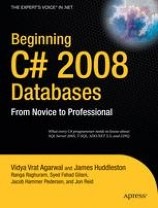
Beginning C# 2008 Databases : From novice to professional
Assuming only basic knowledge of C# 2008, Beginning C# 2008 Databases teaches all the fundamentals of database technology and database programming readers need to quickly become highly proficient database users and application developers. A comprehensive tutorial on both SQL Server 2005 and ADO.NET 3.0, Beginning C# 2008 Databases explains and demonstrates how to create database objects and program against them in both T–SQL and C#. Full of practical, detailed examples, it's been fully revised and updated for C# 2008 and offers the most complete, detailed, and gentle introduction to database technology for all C# programmers at any level of experience.
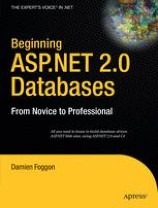
Beginning ASP.NET 2.0 Databases : From novice to professional
Beginning ASP.NET 2.0 Databases: From Novice to Professional is a comprehensive introduction to connecting a website to many different data sourcesnot just databases. You'll learn how to build a relational database, use SQL to communicate with it, and leverage both in your web applications. You'll also learn about the new features of ADO.NET and ASP.NET in .NET 2.0. The authors cover mission-critical issues, such as design, transactions, error handling, optimization, and scalability. They examine SQL Server, Jet, and MySQL databases, and highlight the differences among them.

Becoming citizens in a changing world : IEA international civic and citizenship education study 2016 International Report
Presents the results from the second cycle of the IEA International Civic and Citizenship Education Study (ICCS 2016). Using data from 24 countries in Asia, Europe and Latin America, the study investigates the ways in which young people are prepared to undertake their roles as citizens in a range of countries in the second decade of the 21st century. It also responds to the enduring and emerging challenges of educating young people in a world where contexts of democracy and civic participation continue to change. New developments of this kind include the increase in the use of social media by young people as a tool for civic engagement, growing concerns about global threats and sustainable development, as well as the role of schools in fostering peaceful ways of interaction between young people. Besides enabling the evaluation of a wide range of aspects of civic and citizenship education, including those related to recent developments in a number of countries, the inclusion of test and questionnaire material from the first cycle of the study in 2009 allows the results from ICCS 2016 to be used to examine changes in civic knowledge, attitudes and engagement over seven years.
Beam Instrumentation and Diagnostics
This treatise covers all aspects of the design and the daily operations of a beam diagnostic system for a large particle accelerator. A very interdisciplinary field, it involves contributions from physicists, electrical and mechanical engineers and computer experts alike so as to satisfy the ever-increasing demands for beam parameter variability for a vast range of operation modi and particles. The author draws upon 40 years of research and work, most of them spent as the head of the beam diagnostics group at GSI. He has illustrated the more theoretical aspects with many real-life examples that will provide beam instrumentation designers with ideas and tools for their work.
Basics of fluid mechanics and introduction to computational fluid dynamics
Brings together the theoretical basics of fluid dynamics with a systemaic overview of the appropriate numerical and computational methods for solving the problems presented in the book. Also, effective codes for a majority of the examples are included.
Basic Probability Theory with Applications
This book presents elementary probability theory with interesting and well-chosen applications that illustrate the theory. An introductory chapter reviews the basic elements of differential calculus which are used in the material to follow. The theory is presented systematically, beginning with the main results in elementary probability theory. This is followed by material on random variables. Random vectors, including the all important central limit theorem, are treated next. The last three chapters concentrate on applications of this theory in the areas of reliability theory, basic queuing models, and time series. Examples are elegantly woven into the text and over 400 exercises reinforce the material and provide students with ample practice.
Basic Notions of Algebra
Aims to present a general survey of algebra, of its basic notions and main branches.Those parts of the book devoted to the systematic treatment of notions and results of algebra make very limited demands on the reader: we presuppose only that the reader knows calculus, analytic geometry and linear algebra in the form taught in many high schools and colleges. The extent of the prerequisites required in our treatment of examples is harder to state; an acquaintance with projective space, topological spaces, differentiable and complex analytic manifolds and the basic theory of functions of a complex variable is desirable, but the reader should bear in mind that difficulties arising in the treatment of some specific example are likely to be purely local in nature, and not to affect the understanding of the rest of the book.

Axiom of Choice
AC, the axiom of choice, because of its non-constructive character, is the most controversial mathematical axiom, shunned by some, used indiscriminately by others. This treatise shows paradigmatically that:Disasters happen without AC: Many fundamental mathematical results fail (being equivalent in ZF to AC or to some weak form of AC).Disasters happen with AC: Many undesirable mathematical monsters are being created (e.g., non measurable sets and undeterminate games).Illuminating examples are drawn from diverse areas of mathematics, particularly from general topology, but also from algebra, order theory, elementary analysis, measure theory, game theory, and graph theory.
AVENUE21. Connected and Automated Driving : Prospects for Urban Europe
This publication examines the impact of connected and automated vehicles on the European city and the conditions that can enable this technology to make a positive contribution to urban development. The authors argue for two theses that have thus far received little attention in scientific discourse: as connected and automated vehicles will not be ready for use in all parts of the city for a long time, previously assumed effects – from traffic safety to traffic performance as well as spatial effects – will need to be re-evaluated.
Avatars at Work and Play : Collaboration and Interaction in Shared Virtual Environments
examining uses of shared virtual environments in practical settings such as scientific collaboration, distributed meetings, building models together, and others. It also covers online gaming in virtual environments, which has attracted hundreds of thousands of users and presents an opportunity for studying a myriad of social issues. Covering both ‘work’ and ‘play’, the volume brings together issues common to the two areas.
Autotuning of PID Controllers : A Relay Feedback Approach
Recognising the benefits of improved control, the second edition of Autotuning of PID Controllers provides simple yet effective methods for improving PID controller performance. The practical issues of controller tuning are examined using numerous worked examples and case studies in association with specially written autotuning MATLAB® programs to bridge the gap between conventional tuning practice and novel autotuning methods. Autotuning of PID Controllers is more than just a monograph, it is an independent learning tool applicable to the work of academic control engineers and of their counterparts in industry looking for more effective process control and automation.
Autonomy : In the Law
Autonomy in the Law considers one of the most important benefits of the rule of law. Juxtaposing European and American conceptions of autonomy in the law of families, capital punishment and, criminal trials reveals the common values that justify all legal systems. Law protects the autonomy of individuals and associations by defending the boundaries of their own self-rule. This book illuminates the fundamental purpose of law by examining how European and American lawyers, judges and citizens do and should apply legal autonomy to the practical circumstances of litigation, legislation and the law.
Autonomes fahren : Technische, rechtliche und gesellschaftliche aspekte = Autonomous driving : Technical, legal and social aspects
This book provides answers to a wide range of these and other questions. Experts from Germany and the USA describe central topics related to the automation of vehicles on public roads from an engineering and social science perspective. They show which "decisions" are required of an autonomous vehicle or which "ethics" must be programmed. The authors discuss expectations and concerns that characterize the individual and societal acceptance of autonomous driving. An increased safety potential through autonomous vehicles is compared to the challenges and solution approaches that play a role in securing the safety concept. In addition, they explain what possibilities for change and opportunities arise for our mobility and the reorganization of traffic, not least for freight traffic. The book thus offers an up-to-date, comprehensive and scientifically sound examination of the topic of "autonomous driving".

Automotive software - connected services in mobile networks ; 1st Automotive software workshop, ASWSD 2004, San Diego, CA, USA, January 10-12, 2004, Revised Selected Papers
Software development for the automotive domain is currently subject to a silent revolution. On the one hand, software has become the enabling technology for almost all safety-critical and comfort functions o?ered to the customer. A total of 90 % of all innovations in automotive systems are directly or indirectly - abled by software. the following list highlights three of the corresponding challenges: First, the dependencies between safety-critical and comfort functions are rapidly increasing;a simple example is the interplay of airbag controland power seat control in the case of an accident. Careful analysis and design of these dependencies are necessary to yield correct software solutions. Second, advances in wired and wireless networking infrastructures enable - terconnection between cars and backend service providers .
