



الصفحة 11
الصفحة 11

Embedded Software and Systems ; 3rd International Conference, ICESS 2007, Daegu, Korea, May 14-16, 2007, Proceedings
This book introduces sections on embedded architecture, embedded hardware, embedded software, HW-SW co-design and SoC, multimedia and HCI, pervasive/ubiquitous computing and sensor network, power-aware computing, real-time systems, security and dependability, and wireless communication.

Embedded Java Security : Security for Mobile Devices
Whereas Java brings functionality and versatility to the world of mobile devices, at the same time it also introduces new security threats. The rapid growth of the number of mobile devices that support Java makes this a pressing issue. Embedded Java Security carefully examines the security aspects of Java and offers a security evaluation for the Java platform. After explaining background material on the architecture of embedded platforms and relating to its role in security, the book deconstructs the security model into its main components: It explains each component and relates it to the aim of securing the applications and the device. Toward this end, several implementations of the Java platform are examined and tested to relate the model to its actual implementation on devices. The security holes found are further used to clarify security issues and point out common errors. Finally, the book provides an evaluation of embedded Java security that includes security models and security tests performed on real-life implementations.

Embedded Firmware Solutions : Development Best Practices for the Internet of Things
Embedded Firmware Solutions is the perfect introduction and daily-use field guide--for the thousands of firmware designers, hardware engineers, architects, managers, and developers--to Intel’s new firmware direction (including Quark coverage), showing how to integrate Intel® Architecture designs into their plans. Featuring hands-on examples and exercises using Open Source codebases, like Coreboot and EFI Development Kit (tianocore) and Chromebook, this is the first book that combines a timely and thorough overview of firmware solutions for the rapidly evolving embedded ecosystem with in-depth coverage of requirements and optimization.

Embedded Computer Systems : Architectures, Modeling, and Simulation; 20th International Conference, SAMOS 2020, Samos, Greece, July 5–9, 2020, Proceedings
This book constitutes the refereed proceedings of the 20th International Conference on Embedded Computer Systems: Architectures, Modeling, and Simulation, SAMOS 2020, held in Samos, Greece, in July 2020.* The 16 regular papers presented were carefully reviewed and selected from 35 submissions. In addition, 9 papers from two special sessions were included, which were organized on topics of current interest: innovative architectures for security and European projects on embedded and high performance computing for health applications.

Embedded Computer Systems : Architectures, Modeling, and Simulation ; Vol. 4017 ; 6th International Workshop, SAMOS 2006, Samos, Greece, July 17-20, 2006, Proceedings
This book constitutes the refereed proceedings of the 6th International Workshop on Systems, Architectures, Modeling, and Simulation, SAMOS 2006, held in Samos, Greece on July 2006.The 47 revised full papers presented together with 2 keynote talks were thoroughly reviewed and selected from 130 submissions.

Embedded computer systems : Architectures, modeling, and simulation ; Vol. 3553 ; 5th International Workshop, SAMOS 2005, Samos, Greece, July 18-20, Proceedings
The SAMOS workshop is an international gathering of highly quali?ed researchers from academia and industry, sharing in a 3-day lively discussion on the quiet and - spiring northern mountainside of the Mediterranean island of Samos. As a tradition, the workshop features workshop presentations in the morning, while after lunch all kinds of informal discussions and nut-cracking gatherings take place. The workshop is unique in the sense that not only solved research problems are presented and discussed but also (partly) unsolved problems and in-depth topical reviews can be unleashed in the sci- ti?c arena. Consequently, the workshop provides the participants with an environment where collaboration rather than competition is fostered. The earlier workshops, SAMOS I–IV (2001–2004), were composed only of invited presentations. Due to increasing expressions of interest in the workshop, the Program Committee of SAMOS V decided to open the workshop for all submissions. As a result the SAMOS workshop gained an immediate popularity; a total of 114 submitted papers were received for evaluation. The papers came from 24 countries and regions: Austria (1), Belgium (2), Brazil (5), Canada (4), China (12), Cyprus (2), Czech Republic (1), Finland (15), France (6), Germany (8), Greece (5), Hong Kong (2), India (2), Iran (1), Korea (24), The Netherlands (7), Pakistan (1), Poland (2), Spain (2), Sweden (2), T- wan (1), Turkey (2), UK (2), and USA (5). We are grateful to all of the authors who submitted papers to the workshop.
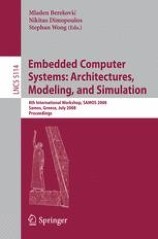
Embedded Computer Systems : Architectures, Modeling, and Simulation ; 8th International Workshop, SAMOS 2008, Samos, Greece, July 21-24, 2008. Proceedings
This book constitutes the refereed proceedings of the 8th International Workshop on Systems, Architectures, Modeling, and Simulation, SAMOS 2008, held in Samos, Greece, in July 2008.

Embedded Computer Systems : Architectures, Modeling, and Simulation ; 7th International Workshop, SAMOS 2007, Samos, Greece, July 16-19, 2007, Proceedings
The book is unique in the sense that not only solved research problems are presented and discussed but also (partly) unsolved pr- lems and in-depth topical reviews can be unleashed in the scientific arena. C- sequently, it provides the participants with an environment where collaboration rather than competition is fostered.

Elevating video content creation with ai assistance = ارتقاء إنشاء محتوى الفيديو بمساعدة الذكاء الاصطناعي
We developed an AI Assistant equipped with features such as description crafting, title generation, keyword extraction, image captioning, clickbait detection, and sentiment analysis.To achieve these functionalities, we proposed a model for generating video descriptions using ResNet50 as a feature extractor and a LSTM network with an attention mechanism as a sequence generator, achieving a BLEU-1 score of 0.907 and a ROUGE-L score of 0.645. For keyword extraction, we utilized Sentence Transformer to identify strategically relevant keywords from the generated descriptions. For title generation, we fine-tuned the BART model, achieving a ROUGE-L score of 0.45. For clickbait detection, we used SVC classifier with linear kernel and TF-IDF vectorization for feature extraction, resulting in 96% accuracy. Our sentiment analysis model using a CNN-LSTM architecture achieved 80% accuracy in analyzing comments on videos. For image captioning, we employed a feature extractor with a CNN layer followed by an LSTM model, achieving a BLEU-1 score of 0.53. Our platform empowers creators by simplifying complex tasks and offering deeper audience engagement insights, making it a powerful tool in the evolving digital content creation.

Electronic house finder
One of the most practical ways to help the Syrian citizens search for suitable and affordable houses is to build an android application for selling, buying and renting houses. This application will ease the process of searching for houses as a whole, and will benefit real estate business owners by enabling them to spread their houses’ offers online. Through exploiting the advantage of the recent wide usage of mobile-based applications by the majority of the Syrian people, we can create an application in which the users are able to post house offers, post specified orders, view posted houses details, and filter their search according to many features (i.e., price and area).

Electronic Government ; 7th International Conference, EGOV 2008, Turin, Italy, August 31 - September 5, 2008. Proceedings
This book constitutes the refereed proceedings of the 7th International Conference on Electronic Government, EGOV 2008, held in Torino, Italy, in August/September 2008 within the DEXA 2008 conference cluster.

ECSCW 2007 ; Proceedings of the 10th European Conference on Computer-Supported Cooperative Work, Limerick, Ireland, 24-28 September 2007
The volume includes papers addressing novel interaction technologies for CSCW systems, new models and architectures for groupware systems, studies of communication and coordination among mobile actors, studies of cooperative work in complex settings, studies of groupware systems in actual use in real-world settings, and theories and techniques to support the development of cooperative applications. The papers present emerging technologies alongside new methods and approaches to the development of this important class of applications.

ECSCW 2005 ; Proceedings of the ninth European conference on computer-supported cooperative work, 18-22 September 2005, Paris, France
These proceedings contain a collection of papers that reflect the variegated research activities in the field. The volume includes papers addressing novel interaction technologies for CSCW systems, new models and architectures for groupware systems, studies of communication and coordination among mobile actors, studies of cooperative work in complex settings, studies of groupware systems in actual use in real-world settings, and theories and techniques to support the development of cooperative applications. The papers present emerging technologies alongside new methods and approaches to the development of this important class of applications. The work in this volume represents the best of the current research and practice within CSCW. The collection of papers presented here will appeal to researchers and practitioners alike, as they combine an understanding of the nature of work with the possibility offered by new technologies.

ECOOP 2008 - Object-Oriented Programming ; 22nd European Conference Paphos, Cyprus, July 7-11, 2008 Proceedings
This book constitutes the refereed proceedings of the 22nd European Conference on Object-Oriented Programming, ECOOP 2008, held in Paphos, Cyprus, in July 2008.

ECOOP 2007 – Object-Oriented Programming ; 21th European Conference, Berlin, Germany, July 30 - August 3, 2007, Proceedings
This book contains sections on runtime implementation, empirical studies, programs and predicates, language design, inheritance and derivation, aspects, as well as language about language.

ECOOP 2002 - Object-Oriented Programming ; 16th European Conference Malaga, Spain, June 10-14, 2002 Proceedings
Constitutes the proceedings of the 16th European Conference on Object-Oriented Programming held in Spain in 2002. The 25 papers cover aspect-oriented software development, Java virtual machines, distributed systems, patterns and architectures, languages, optimization and more.

Early Aspects: Current Challenges and Future Directions ; 10th International Workshop, Vancouver, Canada, March 13, 2007, Revised Selected Papers
Traditionally, aspect-oriented software development (AOSD) has focused on the implementation phase of the software lifecycle: aspects are identified and captured mainly in code. Therefore, most current AOSD approaches place the burden for aspect identification and management on the programmer working at low levels of abstraction. However, aspects are often present well before the implementation phase, such as in domain models, requirements and software architecture. Identification and capture of these early aspects ensure that aspects related to the problem domain (as opposed to merely the implementation) will be appropriately captured, reasoned about and available. This offers improved opportunities for early recognition and negotiation of trade-offs and allows forward and backward aspect traceability. This makes requirements, architecture, and implementation more seamless, and allows a more systematic application of aspects.

Dynamics AX : A guide to microsoft axapta
The world’s leading Axapta 3.0 experts will take you from Axapta novice to pro in this book. This authoritative and comprehensive guide walks you gently through the bulk of what you need to know to productively apply the system in the real worldwith real data, sizing guidelines, deployment architectures, and code. By the book’s end, you will have acquired practical hands-on experience. You’ll be able to get Axapta 3.0 up and running, and identify gaps between the out-of-the-box product and your actual business needs. You’ll also know how to automate real-world business functions.

Dr.phone
Dr phone is a software system that helps in talking with the doctor automatically and easily without the need to go to the doctor's clinic to diagnose the patient's condition. our application presents an available platform to make a video call between the doctor and the patient according to the patient’s needs. The system accepts the patient’s request after choosing an available doctor andthen waits for the doctor to accept his request, if there is no doctor available, the system performs an AI chatbot to the patient's need to give him the appropriate diagnosis. when the call finished the doctor represents medical record including the medicine and the analytics and record the next appointment if it’s needed then send them to the patient's email, the patient also can see the nearest pharmacies or labs according to his location, and finally the patient rates the doctor after the call is finished then payment by his available wallet.

Domain-driven design with Java, a practitioner's guide : create simple, elegant, and valuable software solutions for complex business problems
Helps you as a developer and architect to put your knowledge to work in order to create elegant software designs that are enjoyable to work with and easy to reason about. You'll begin with an introduction to the concepts of domain-driven design and discover various ways to apply them in real-world scenarios. You'll also appreciate how DDD is extremely relevant when creating cloud native solutions that employ modern techniques such as event-driven microservices and fine-grained architectures. As you advance through the chapters, you'll get acquainted with core DDD's strategic design concepts such as the ubiquitous language, context maps, bounded contexts, and tactical design elements like aggregates and domain models and events. You'll understand how to apply modern, lightweight modeling techniques such as business value canvas, Wardley mapping, domain storytelling, and event storming, while also learning how to test-drive the system to create solutions that exhibit high degrees of internal quality.
