



الصفحة 11
الصفحة 11

Construction and analysis of safe, secure, and interoperable smart devices ; Vol. 3362 : International workshop, CASSIS 2004, Marseille, France, March 10-14, 2004, Revised Selected Papers
History based access control and secure information flow / The spec# programming system / Mastering test generation from smart card software formal models / A mechanism for secure, fine-grained dynamic provisioning of applications on small devices / A type system for checking applet isolation in java card / Verification of safety properties in the presence of transactions / Modelling mobility aspects of security policies / Smart devices for next generation mobile services / A flexible framework for the estimation of coverage metrics in explicit state software model checking / Combining several paradigms for circuit validation and verification / Smart card research perspectives

Conceptual Modeling of Information Systems
When designing an information system, conceptual modeling is the activity that elicits and describes the general knowledge the system needs to know. This description, called the conceptual schema, is necessary in order to develop an information system.textbook explains in detail the principles of conceptual modeling independently from particular methods and languages and shows how to apply them in real-world projects. It covers all aspects of the engineering process from structural modeling over behavioral modeling to meta-modeling, and completes the presentation with an extensive case study based on the osCommerce system, an online store-management software program freely available under the GNU General Public License. His presentation is based on well-known industry standards like UML and OCL as a particular conceptual modeling language, yet also delivers the basics of the formal logical language background.

Concepts and Semantics of Programming Languages 2 : Modular and Object-oriented Constructs with OCaml, Python, C++, Ada and Java
Explores the syntactical constructs of the most common programming languages, and sheds a mathematical light on their semantics, providing also an accurate presentation of the material aspects that interfere with coding. Presents an original semantic model, collectively taking into account all of the constructs and operations of modules and classes: visibility, import, export, delayed definitions, parameterization by types and values, extensions, etc. The model serves for the study of Ada and OCaml modules, as well as C header files. It can be deployed to model object and class features, and is thus used to describe Java, C++, OCaml and Python classes.

Concepts and Semantics of Programming Languages 1 : A Semantical Approach with OCaml and Python
Explores the syntactical constructs of the most common programming languages, and sheds a mathematical light on their semantics, while also providing an accurate presentation of the material aspects that interfere with coding. It is dedicated to functional and imperative features. Included is the formal study of the semantics of typing and execution; their acquisition is facilitated by implementation into OCaml and Python, as well as by worked examples. Data representation is considered in detail: endianness, pointers, memory management, union types and pattern-matching, etc., with examples in OCaml, C and C++. The second volume introduces a specific model for studying modular and object features and uses this model to present Ada and OCaml modules, and subsequently Java, C++, OCaml and Python classes and objects.

Computing Attitude and Affect in Text : Theory and Applications
Human Language Technology (HLT) and Natural Language Processing (NLP) systems have typically focused on the “factual” aspect of content analysis. Other aspects, including pragmatics, opinion, and style, have received much less attention. However, to achieve an adequate understanding of a text, these aspects cannot be ignored. The chapters in this book address the aspect of subjective opinion, which includes identifying different points of view, identifying different emotive dimensions, and classifying text by opinion. Various conceptual models and computational methods are presented.

Computing and combinatorics ; Vol. 3595 ; 11th Annual International Conference, COCOON 2005, Kunming, China, August 16-19, 2005, Proceedings
The papers in this volume were presented at theEleventh Annual InternationalComputing and Combinatorics Conference(COCOON 2005), The topics cover most aspects of theoretical computerscience and combinatorics related to computing.Submissions to the conference this year were conducted electronically. A totalof 353 papers were submitted, of which 96 were accepted.
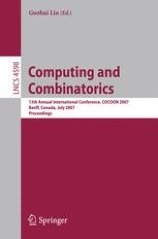
Computing and Combinatorics ; 13th Annual International Conference, COCOON 2007, Banff, Canada, July 16-19, 2007, Proceedings
The Book covers most aspects of theoretical computer scienceand combinatorics related to computing.It exploring research, development, and novel applications of computing and combinatorics.

Computers and Games ; 5th International Conference, CG 2006, Turin, Italy, May 29-31, 2006, Revised Papers
This book covers all aspects of artificial intelligence in computer-game playing. Topics addressed are evaluation and learning, search, combinatorial games and theory opening and endgame databases, single-agent search and planning, and computer Go.

Computer-Aided Innovation (CAI) ; IFIP 20th World Computer Congress, Proceedings of the Second Topical Session on Computer-Aided Innovation, WG 5.4/TC 5 Computer-Aided Innovation, September 7-10, 2008, Milano, Italy
The IFIP series publishes state-of-the-art results in the sciences and technologies of information and communication. The principal aim of the IFIP series is to encourage education and the dissemination and exchange of information about all aspects of computing.

Computer-Aided Design of User Interfaces V ; Proceedings of the 6th International Conference on Computer-Aided Design of User Interfaces CADUI '06 (6-8 June 2006, Bucharest, Romania)
Today, the development life cycle of 3D User Interfaces (UIs) mostly remains an art more than a principled-based approach. Several methods [1,3,7,8,9,10,11,15,17,18,19] have been introduced to decompose this life cycle into steps and sub-steps, but these methods rarely provide the design knowledge that should be typically used for achieving each step. In addition, the development life cycle is more focusing directly on the programming - sues than on the design and analysis phases. This is sometimes reinforced by the fact that available tools for 3D UIs are toolkits, interface builders, r- dering engines, etc. When there is such a development life cycle defined, it is typically structured into the following set of activities: 1. The conceptual phase is characterized by the identification of the content and interaction requests. The meta-author discusses with the interface designer to take advantage of the current interaction technology. The int- face designer receives information about the content. The result of this phase is the production of UI schemes (e. g. , written sentences, visual schemes on paper) for defining classes of interactive experiences (e. g. , class Guided tour). Conceptual schemes are produced both for the final users and the authors. The meta-author has a deep knowledge of the c- tent domain and didactic skills too. He/she communicates with the final user too, in order to focus on didactic aspects of interaction. 2.

Computer Viruses : from theory to applications
The purpose of this book is to propose a teaching approach to under- 1 stand what computer viruses really are and how they work. To do this, three aspects are covered ranging from theoretical fundamentals, to pr- tical applications and technical features; fully detailed, commented source 1 We will systematically use the plural form “viruses” instead of the litteral one “virii”. The latter is now an obsolete, though gramatically recommended, form. VIII Preface codes of viruses as well as inherent applications are proposed. So far, the applications-oriented aspects have hardly ever been addressed through the scarce existing literature devoted to computer viruses.

Computer Science Logic ; Vol. 3634
This book constitutes the refereed proceedings of the 19th International Workshop on Computer Science Logic, CSL 2005, held as the 14th Annual Conference of the EACSL in Oxford, UK in August 2005. The 33 revised full papers presented together with 4 invited contributions were carefully reviewed and selected from 108 papers submitted. All current aspects of logic in computer science are addressed ranging from mathematical logic and logical foundations to methodological issues and applications of logics in various computing contexts. The volume is organized in topical sections on semantics and logics, type theory and lambda calculus, linear logic and ludics, constraints, finite models, decidability and complexity, verification and model checking, constructive reasoning and computational mathematics, and implicit computational complexity and rewriting.

Computer science : Theory and applications ; 15th International computer science symposium in Russia, CSR 2020, Yekaterinburg, Russia, June 29 – July 3, 2020, Proceedings
This book constitutes the proceedings of the 15th International Computer Science Symposium in Russia, CSR 2020, held in Yekaterinburg, Russia, in June 2020. The 25 full papers and 6 invited papers were carefully reviewed and selected from 49 submissions. The papers cover a broad range of topics, such as: algorithms and data structures; computational complexity, including hardness of approximation and parameterized complexity; randomness in computing, approximation algorithms, fixed-parameter algorithms; combinatorial optimization, constraint satisfaction, operations research; computational geometry; string algorithms; formal languages and automata, including applications to computational linguistics; codes and cryptography; combinatorics in computer science; computational biology; applications of logic to computer science, proof complexity; database theory; distributed computing; fundamentals of machine learning, including learning theory, grammatical inference and neural computing; computational social choice; quantum computing and quantum cryptography; theoretical aspects of big data.

Computer safety, reliability, and security ; Vol. 3688
This book constitutes the refereed proceedings of the 24th International Conference on Computer Safety, Reliability, and Security, SAFECOMP 2005, held in Fredrikstad, Norway, in September 2005. The 30 revised full papers were carefully reviewed and selected for inclusion in the book. The papers address all aspects of dependability and survivability of critical computerized systems in various branches and infrastructures.

Computer Network Security ; Vol. 3685
This volume contains papers presented at the 3rd International Workshop on Mathematical Methods, Models and Architectures for Computer Network - curity (MMM-ACNS 2005) held in St. Petersburg, Russia, 2005. The 1st and the 2nd International Workshops on Mathematical Methods, Models and Architectures for Computer Network Security (MMM-ACNS 2001 and MMM-ACNS 2003), hosted by the St. Petersburg Institute for Informatics and Automation, demonstrated the keen interest of the international research community in the subject area. It was recognized that conducting a biannual series of such workshops in St. Petersburg stimulates fruitful exchanges between the di?erent schools of thought, facilitates the dissemination of new ideas and promotesthespirit of cooperationbetweenresearchersontheinternationalscale. MMM-ACNS 2005 provided an international forum for sharing original - search results and application experiences among specialists in fundamental and applied problems of computer network security. An important distinction of the workshop was its focus on mathematical aspects of information and computer network security addressing the ever-increasing demands for secure computing and highly dependable computer networks.

Computer Network Security ; 4th International Conference on Mathematical Methods, Models and Architectures for Computer Network Security, MMM-ACNS 2007, St. Petersburg, Russia, September 13-15, 2007, Proceedings
This volume focus on mathematical aspects of information and computer network security addressing the ever-increasing demands for secure computing and highly dependable computer networks.

Computer Music Modeling and Retrieval ; Vol. 3310
This volume contains the final proceedings for the 2004 Computer Music Model-ing and Retrieval Symposium (CMMR 2004). CMMR is an annualevent focusing on important aspects of computer music. CMMR 2004 is the sec-ond event in this series. The use of computers in music is well established. CMMR 2004 provided aunique opportunity to meet and interact with peers concerned with the cross-influence of the technological and creative in computer music. The field of com-puter music is interdisciplinary by nature and closely related to a number of com-puter science and engineering areas such as information retrieval, programming,human computer interaction, digital libraries, hypermedia, artificial intelligence,acoustics, signal processing, etc. The event gathered many interesting people(researchers, educators, composers, performers, and others). There were manyhigh-quality keynote and paper presentations, that fostered inspiring discussions.

Computer graphics and geometric modelling : Implementation & algorithms
Possibly the most comprehensive overview of computer graphics as seen in the context of geometric modelling, this two volume work covers implementation and theory in a thorough and systematic fashion. Computer Graphics and Geometric Modelling: Implementation and Algorithms, covers the computer graphics part of the field of geometric modelling and includes all the standard computer graphics topics. The first part deals with basic concepts and algorithms and the main steps involved in displaying photorealistic images on a computer. The second part covers curves and surfaces and a number of more advanced geometric modelling topics including intersection algorithms, distance algorithms, polygonizing curves and surfaces, trimmed surfaces, implicit curves and surfaces, offset curves and surfaces, curvature, geodesics, blending etc. The third part touches on some aspects of computational geometry and a few special topics such as interval analysis and finite element methods. The volume includes two companion programs.

Computer And Computing Technologies In Agriculture, Vol. II ; 1st IFIP TC 12 International Conference on Computer and Computing Technologies in Agriculture (CCTA 2007), Wuyishan, China, August 18-20, 2007
The IFIP series publishes state-of-the-art results in the sciences and technologies of information and communication. The principal aim of the IFIP series is to encourage education and the dissemination and exchange of information about all aspects of computing.

Computer And Computing Technologies In Agriculture, Vol. I ; 1st IFIP TC 12 International Conference on Computer and Computing Technologies in Agriculture (CCTA 2007), Wuyishan, China, August 18-20, 2007
The IFIP series publishes state-of-the-art results in the sciences and technologies of information and communication. The principal aim of the IFIP series is to encourage education and the dissemination and exchange of information about all aspects of computing.
