



الصفحة 108
الصفحة 108

Algorithms and Complexity ; 6th Italian Conference, CIAC 2006, Rome, Italy, May 29-31, 2006, Proceedings
Here are the refereed proceedings of the 6th Italian Conference on Algorithms and Computation, CIAC 2006. The 33 revised full papers presented together with 3 invited papers address such topics as sequential, parallel and distributed algorithms, data structures, approximation algorithms, randomized algorithms, on-line algorithms, graph algorithms, analysis of algorithms, algorithm engineering, algorithmic game theory, computational biology, computational complexity, communication networks, computational geometry, cryptography, discrete optimization, graph drawing, mathematical programming, and quantum algorithms.
Algorithms and architectures for parallel processing ; 8th International Conference, ICA3PP 2008, Cyprus, June 9-11, 2008 Proceedings
This book constitutes the refereed proceedings of the 8th International Conference on Algorithms and Architectures for Parallel Processing, ICA3PP 2008, held in Agia Napa, Cyprus, in June 2008.
Algorithms and architectures for parallel processing ; 7th International Conference, ICA3PP 2007, Hangzhou, China, June 11-14, 2007, Proceedings
The improvements in computation and communication capabilities have enabled the creation of demanding applications in critical domains such as the environment, health, aerospace, and other areas of science and technology. Similarly, new classes of applications are enabled by the availability of heterogeneous large-scale distributed systems which are becoming available nowadays (based on technologies such as grid and peer-to-peer systems).Parallel computing systems exploit a large diversity of computer architectures, from supercomputers, shared-memory or distributed-memory multi processors, to local networks and clusters of p- sonal computers. With the recent emergence of multi core architectures, parallel computing is now set to achieve “mainstream” status. Approaches that have been advocated by parallel computing researchers in the past are now being utilized in a number of software libraries and hardware systems that are available for everyday use. Parallel computing ideas have also come to dominate areas such as multi user gaming (especially in the development of gaming engines based on “cell” arc- tectures).

Algorithms - ESA 2008 ; 16th Annual European Symposium, Karlsruhe, Germany, September 15-17, 2008. Proceedings
This book constitutes the refereed proceedings of the 16th Annual European Symposium on Algorithms, ESA 2008, held in Karlsruhe, Germany, in September 2008 in the context of the combined conference ALGO 2008.
Algorithms – ESA 2007 ; 15th Annual European Symposium, Eilat, Israel, October 8-10, 2007, Proceedings
This book presented submissions in the engineering and applications track. The papers address all current subjects in algorithmics reaching from design and analysis issues of algorithms over to real-world applicat.

Algorithms - ESA 2006 ; 14th Annual European Symposium, Zurich, Switzerland, September 11-13, 2006, Proceedings
This book constitutes the refereed proceedings of the 14th Annual European Symposium on Algorithms, ESA 2006, held in Zurich, Switzerland, in the context of the combined conference ALGO 2006. The book presents 70 revised full papers together with abstracts of 3 invited lectures. The papers address all current subjects in algorithmics, reaching from design and analysis issues of algorithms over to real-world applications and engineering of algorithms in various fields.
Algorithms – ESA 2005 ; 13th Annual European Symposium, Palma de Mallorca, Spain, October 3-6, 2005, Proceedings
This volume contains the 75 contributed papers and the abstracts of the threeinvited lectures presented at the 13th Annual European Symposium on Algo-rithms (ESA 2005), held in Spain, 2005. respectively.Papers were solicited in all areas of algorithmic research, including but notlimited to algorithmic aspects of networks, approximation and on-line algo-rithms, computational biology, computational geometry, computational financeand algorithmic game theory, data structures, database and information re-trieval, external memory algorithms, graph algorithms, graph drawing, machinelearning, mobile computing, pattern matching and data compression, quantumcomputing, and randomized algorithms. The algorithms could be sequential,distributed, or parallel. Submissions were especially encouraged in the area ofmathematical programming and operations research, including combinatorialoptimization, integer programming, polyhedral combinatorics, and semidefiniteprogramming.Each extended abstract was submitted to one of the two tracks.

Algorithmic number theory ; 8th International Symposium, ANTS-VIII Banff, Canada, May 17-22, 2008 Proceedings
This book constitutes the refereed proceedings of the 8th International Algorithmic Number Theory Symposium, ANTS 2008, held in Banff, Canada, in May 2008.

Algorithmic number theory ; 7th International Symposium, ANTS-VII, Berlin, Germany, July 23-28, 2006, Proceedings
This book constitutes the refereed proceedings of the 7th International Algorithmic Number Theory Symposium, ANTS 2006, held in Berlin, July 2006. The book presents 37 revised full papers together with 4 invited papers selected for inclusion. The papers are organized in topical sections on algebraic number theory, analytic and elementary number theory, lattices, curves and varieties over fields of characteristic zero, curves over finite fields and applications, and discrete logarithms.
Algorithmic methods for railway optimization ; International Dagstuhl workshop, railway optimization 2004, Dagstuhl Castle, Germany, June 20-25, 2004, Bergen, Norway, September 16-17, 2004, Revised Selected Papers
This state-of-the-art survey features papers that were selected after an open call following the International Dagstuhl Seminar on Algorithmic Methods for Railway Optimization. The second part of the volume constitutes the refereed proceedings of the 4th International Workshop on Algorithmic Methods and Models for Optimization of Railways.

Algorithmic learning theory ; Vol.4264 : 17th International Conference, ALT 2006, Barcelona, Spain, October 7-10, 2006, Proceedings
This book constitutes the refereed proceedings of the 17th International Conference on Algorithmic Learning Theory, ALT 2006, held in Barcelona, Spain in October 2006, colocated with the 9th International Conference on Discovery Science, DS 2006.The 24 revised full papers presented together with the abstracts of five invited papers were carefully reviewed and selected from 53 submissions. The papers are dedicated to the theoretical foundations of machine learning.
Algorithmic learning theory ; Vol. 3734 ; 16th international conference, ALT 2005, Singapore, October 8-11, 2005, Proceedings
This volume contains the papers presented at the 16th Annual InternationalConference on Algorithmic Learning Theory (ALT 2005), which was held (Republic of Singapore), 2005. The main objective of theconference is to provide an interdisciplinary forum for the discussion of the the-oretical foundations of machine learning as well as their relevance to practicalapplications. The volume includes 30 technical contributions, which were selected by theprogram committee from 98 submissions.

Algorithmic learning theory ; 19th International Conference, ALT 2008, Budapest, Hungary, October 13-16, 2008. Proceedings
This book constitutes the refereed proceedings of the 19th International Conference on Algorithmic Learning Theory, ALT 2008, held in Budapest, Hungary, in October 2008, co-located with the 11th International Conference on Discovery Science, DS 2008.

Algorithmic learning theory ; 18th International conference, ALT 2007, Sendai, Japan, October 1-4, 2007, Proceedings
This volume contains the papers presented at the 18th International Conf- ence on Algorithmic Learning Theory.The main objective of the conference was to provide an interdisciplinary forum for high-quality talks with a strong theore- cal background and scientiبهc interchange in areas such as query models, on-line learning, inductive inference, algorithmic forecasting, boosting, support vector machines, kernel methods, complexity and learning, reinforcement learning, - supervised learning and grammatical inference.

Algorithmic Learning in a Random World
This new monograph integrates mathematical theory and revealing experimental work. It demonstrates mathematically the validity of the reliability claimed by conformal predictors when they are applied to independent and identically distributed data, and it confirms experimentally that the accuracy is sufficient for many practical problems. Later chapters generalize these results to models called repetitive structures, which originate in the algorithmic theory of randomness and statistical physics. The approach is flexible enough to incorporate most existing methods of machine learning, including newer methods such as boosting and support vector machines and older methods such as nearest neighbors and the bootstrap.
Algorithmic Game Theory ; 1st International Symposium, SAGT 2008, Paderborn, Germany, April 30-May 2, 2008. Proceedings
This book constitutes the refereed proceedings of the First International Symposium on Algorithmic Game Theory, SAGT 2008, held in Paderborn, Germany, in April/May 2008.
Algorithmic Aspects of Wireless Sensor Networks ; 4th International Workshop, ALGOSENSORS 2008, Reykjavik, Iceland, July 2008. Revised Selected Papers
This book constitutes the reviewed proceedings of the Fourth International Workshop on Algorithmic Aspects of Wireless Sensor Networks, ALGOSENSORS 2008, held in Reykjavik, Iceland, Wroclaw, Poland, July 12, 2008.
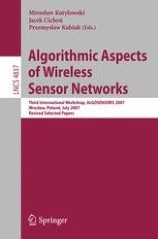
Algorithmic Aspects of Wireless Sensor Networks ; 3rd International Workshop, ALGOSENSORS 2007, Wroclaw, Poland, July 14, 2007, Revised Selected Papers
This book contains the proceedings of the Third International Workshop on Algorithmic Aspects of Wireless Sensor Networks. Coverage includes abstract models, complexity-theoretic results, and the design and analysis of algorithms for wireless sensor networks.
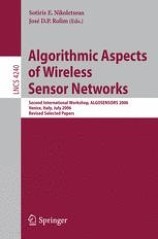
Algorithmic Aspects of Wireless Sensor Networks ; 2nd International Workshop, ALGOSENSORS 2006, Venice, Italy, July 15, 2006, Revised Selected Papers
This volume contains the contributed papers and invited talks presented at the 1stInternational Workshop on Algorithmic Aspect sof Wireless Sensor Networks (ALGOSENSORS 2004), which was held July 16, 2004, in Turku, Finland, - located with the 31st International Colloquium on Automata, Languages, and Programming (ICALP 2004). Wireless ad hoc sensor networks have become a very important research subject due to their potential to provide diverse services in numerous appli- tions. The realization of sensor networks requires intensive technical research and development e?orts, especially in power-aware scalable wireless ad hoc c- munications protocols, due to their unusual application requirements and severe constraints. On the other hand, a solid theoretical background seems necessary for sensor networks to achieve their full potential. It is an algorithmic challenge to achieve e?cient and robust realizations of such large, highly dynamic, complex, n- conventional networking environments
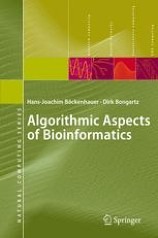
Algorithmic Aspects of Bioinformatics
Advances in bioinformatics and systems biology require improved computational methods for analyzing data, while progress in molecular biology is in turn influencing the development of computer science methods. This book introduces some key problems in bioinformatics, discusses the models used to formally describe these problems, and analyzes the algorithmic approaches used to solve them. After introducing the basics of molecular biology and algorithmics, Part I explains string algorithms and alignments; Part II details the field of physical mapping and DNA sequencing; and Part III examines the application of algorithmics to the analysis of biological data. Exciting application examples include predicting the spatial structure of proteins, and computing haplotypes from genotype data. This book describes topics in detail and presents formal models in a mathematically precise, yet intuitive manner, with many figures and chapter summaries, detailed derivations, and examples. It is well suited as an introduction into the field of bioinformatics, and will benefit students and lecturers in bioinformatics and algorithmics, while also offering practitioners an update on current research topics.
