



الصفحة 10
الصفحة 10

Embedded and Ubiquitous Computing - EUC 2005 ; International Conference EUC 2005, Nagasaki, Japan, December 6-9, 2005, Proceedings
Welcome to the proceedings of the 2005 IFIP International Conference on - bedded and Ubiquitous Computing (EUC 2005), which was held in Nagasaki, Japan, December 6–9, 2005. Embedded and ubiquitous computing is emerging rapidly as an exciting new paradigm to provide computing and communication services all the time, - erywhere. Its systems are now pervading every aspect of life to the point that they are hidden inside various appliances or can be worn unobtrusively as part of clothing and jewelry. This emergence is a natural outcome of research and technological advances in embedded systems, pervasive computing and c- munications, wireless networks, mobile computing, distributed computing and agent technologies, etc. Its tremendous impact on academics, industry, gove- ment, and daily life can be compared to that of electric motors over the past century, in fact it but promises to revolutionize life much more profoundly than elevators, electric motors or even personal computers. The EUC 2005 conference provided a forum for engineers and scientists in academia, industry, and government to address profound issues including te- nical challenges, safety, and social, legal, political, and economic issues, and to present and discuss their ideas, results, work in progress, and experience on all aspects of embedded and ubiquitous computing.

E-Government : Towards electronic democracy ; International Conference, TCGOV 2005, Bolzano, Italy, March 2-4, 2005, Proceedings
The TCGOV 2005 international conference on e-government was held at the Free University of Bozen-Bolzano during March 2–4, 2005. The conference was initiated by the working group “Towards Electronic Democracy” (TED) of the European Science Foundation and was jointly organized by the Free University ofBozen-Bolzano,theMunicipalityofBozen-Bolzano,theTEDWorkingGroup, and the IFIP Working Group 8.5. The conference addressed a large spectrum of issues that are relevant and have to be investigated for a successful transition from the traditional form of government to a new form known as e-government. The main focus was on the following topics: – improving citizen participation and policy making (e-democracy) – government application integration – semantic Web technologies for e-government – security aspects for e-government services Two sessions were dedicated to e-democracy, an emerging area within- government that seeks to enhance democratic processes and provide increased opportunities for individuals and communities to be involved in governmental decisions.

Education for the 21st Century - Impact of ICT and Digital Resources ; IFIP 19th World Computer Congress, TC-3 Education, August 21-24, 2006, Santiago, Chile
The IFIP series publishes state-of-the-art results in the sciences and technologies of information and communication. The scope of the series includes: foundations of computer science; software theory and practice; education; computer applications in technology; communication systems; systems modeling and optimization; information systems; computers and society; computer systems technology; security and protection in information processing systems; artificial intelligence; and human-computer interaction. Proceedings and post-proceedings of referred international conferences in computer science and interdisciplinary fields are featured.

E-Commerce and Web Technologies ; Vol. 4082 ; 7th International Conference, EC-Web 2006, Krakow, Poland, September 5-7, 2006, Proceedings
EC-Web 2006 served as a forum bringing together researchers from academia and practitioners from industry to discuss the current state of the art in e-commerce and Web technologies. Inspiration and new ideas emerged from intensive discussions that took place during the keynote address, the formal sessions and the social events. The conference attracted 88 paper submissions and each paper was reviewed by three Program Committee members. The Program Committee selected 24 papers for presentation and publication (an acceptance and publication rate of 27%).

E-Commerce and Web Technologies ; Vol. 3590 ; 6th International conference, EC-Web 2005, Copenhagen, Denmark, August 23-26, 2005, Proceedings
We welcome you to the 6th International Conference on E-Commerce and Web Technology (EC-Web 2005) held in Copenhagen, Denmark. It was held in conjunction with DEXA 2005. This conference was organized for the first time in Greenwich, UK, in 2000, and it has been able to attract an increasing number of participants and interest, reflecting the progress made in the field. As in the five previous years, EC-Web 2005 served as a forum that brought together researchers from academia and practitioners from industry to discuss the current state of the art in e-commerce and Web technologies.

E-Commerce and Web Technologies ; 9th International Conference, EC-Web 2008 Turin, Italy, September 3-4, 2008 Proceedings
This book constitutes the refereed proceedings of the 9th International Conference on Electronic Commerce and Web Technologies, EC-Web 2008, held in Turin, Italy, in September, 2008 in conjunction with Dexa 2008.

E-Commerce and Web Technologies ; 8th International Conference, EC-Web 2007, Regensburg, Germany, September 3-7, 2007, Proceedings
This book contains sections on recommender systems, business process / design aspects, mobile commerce, security and e-payment, Web services computing / semantic Web, e-negotiation and agent mediated systems, and issues in Web advertising.

E-Business@Print : Internet-based services and processes
The Internet has opened up exciting new opportunities for print media companies, enabling information to be processed for both paper and online output. It also offers new possibilities for print media companies to work increasingly closely with customers and production partners. The author provides a comprehensive overview of the new services that are now available and the new processes that the Internet enables. The reader is systematically guided through the various specialist terms, and numerous examples are used to illustrate possible applications, e.g. online editing systems, Web-based project management tools and online tracking of print jobs.

E-business and telecommunication networks ; 1st International conference, ICETE 2004, Setúbal, Portugal,
This book contains the best papers of the First International Conference on e-Business and Telecommunication Networks (ICETE 2004), held in Setúbal (Portugal). The conference was organized by INSTICC (Institute for Systems and Technologies of Information, Communication and Control) in collaboration with the School of Business of the Polytechnic Institute of Setúbal, who hosted the event. This conference represented a major initiative to increase the technical exchanges among professionals, who work in the e-Business and Telecommunication Networks fields, and who are implementing new services and technologies affecting the lives of ordinary consumers.

DOM Scripting : Web Design with JavaScript and the Document Object Model
There are three main technologies married together to create usable, standards-compliant web designs: XHTML for data structure, Cascading Style Sheets for styling your data, and JavaScript for adding dynamic effects and manipulating structure on the fly using the Document Object Model. This book is about the latter of the three. DOM Scripting: Web Design with JavaScript and the Document Object Model gives you everything you need to start using JavaScript and the Document Object Model to enhance your web pages with client-side dynamic effects. Jeremy Keith starts off by giving you a basic crash course in JavaScript and the DOM, then moves on to provide you with several real-world examples built up from scratch, including dynamic image galleries and dynamic menus. Then, he shows you how to manipulate web page style using the CSS DOM, and create markup on the fly.

Distributed systems and mobile computing
About Distributed Systems and Mobile Computing. This is a branch of Computer Science devoted to the study of systems whose components are in different physical locations and have limited communication capabilities. Such components may be static, often organized in a network, or may be able to move in a discrete or continuous environment. The theoretical study of such systems has applications ranging from swarms of mobile robots (e.g., drones) to sensor networks, autonomous intelligent vehicles, the Internet of Things, and crawlers on the Web. The book includes five articles. Two of them are about networks: the first one studies the formation of networks by agents that interact randomly and have the ability to form connections; the second one is a study of clustering models and algorithms. The three remaining articles are concerned with autonomous mobile robots operating in continuous space.

Distributed Services with OpenAFS : For Enterprise and Education
This book shows in detail how to build enterprise-level secure, redundant, and highly scalable services from scratch on top of the open source Linux operating system, suitable for small companies as well as big universities. The core architecture presented is based on Kerberos, LDAP, AFS, and Samba. It is shown how to integrate web, message related, data base and other services with this backbone. This architecture provides a Single-Sign-On solution for different client platforms and can also be employed for clustering. Although it is implemented with Debian GNU/Linux, the content can be applied to other UNIX flavors.

Distributed network systems : From concepts to implementations
This textbook covers both theoretical and practical aspects of distributed computing. It describes the client-server model for developing distributed network systems, the communication paradigms used in a distributed network system, and the principles of reliability and security in the design of distributed network systems. Based on theoretical introductions, the book presents various implementation strategies and techniques for building distributed network systems, including examples in TCP/IP communications, the use of remote procedure call and remote method invocation techniques, and the development of web-based applications, distributed databases, and mobile computing systems.

Distributed computing and internet Technology ; Vol. 3816 ; 2nd International conference, ICDCIT 2005, Bhubaneswar, India, December 22-24, 2005, Proceedings
The opening ceremony and pre-conference tutorials on various related topics were held on December 21. The technical program started on December 22 and continued for three days. The program was arranged in single track so as to enable participants to attend sessions of di?erent tracks. Papers from the DM, IT, SE, and SS tracks were divided into two sessions, whereas DC track sessions were held on the ?rst two days of the conference. The program also included two plenary talks. The ?rst talk was delivered by S. S. Iyengar from Louisiana State University, USA. The second talk was delivered by He Jifeng from the International Institute for Software Technology (IIST) Macau. Prof. Iyenger’s talk on “The Distributed Sensor Networks — An Emerging Technology” was focused on new ideas about the use of distributed systems for emerging technology, while Prof. Jifeng’s talk on “Linking Theories of Concurrency by Retraction” dealt with semantics of concurrency.
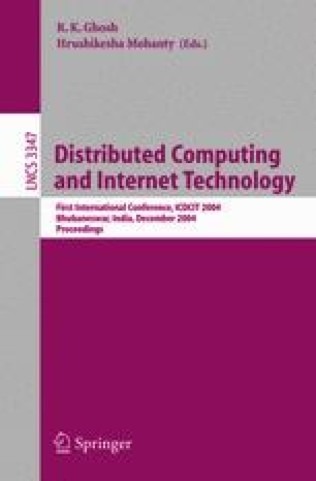
Distributed computing and Internet Technology ; 1st International Conference, ICDCIT 2004, Bhubaneswar, India, December 22-24, 2004, Proceedings
Taming the Dynamics of Disributed Data - DISTRIBUTED COMPUTING -- Data in Your Space -- Enabling Technologies for Harnessing Information Explosion -- Fair Leader Election by Randomized Voting -- An Efficient Leader Election Algorithm for Mobile Ad Hoc Networks -- Distributed Balanced Tables: A New Approach - Performance Evaluation of Gigabit Ethernet and SCI in a Linux Cluster -- Performance Evaluation of a Modified-Cyclic-Banyan Based ATM / IP Switching Fabric -- A Scalable and Robust QoS Architecture for WiFi P2P Networks -- NEC: Node Energy Based Clustering Protocol for Wireless Sensor Networks with Guaranteed Connectivity,and other

Distributed Applications and Interoperable Systems ; Vol. 4025 ; 6th IFIP WG 6.1 International Conference, DAIS 2006, Athens, Greece, June 14-16, 2006
This volume contains the proceedings of the IFIP WG 6.1 International Working Conference on Distributed Applications and Interoperable Systems VI held in Bologna, Italy, on June 14-16, 2006. The conference program presents the state of the art in research on d- tributed and interoperable systems. In recent years, distributed applications have indeed gained a practical and widely-known footing in everyday computing.

Distributed applications and interoperable systems ; Vol. 3543 ; 5th IFIP WG 6.1 International conference, DAIS 2005, Athens, Greece, June 15-17, 2005, Proceedings
ThisvolumecontainstheproceedingsoftheIFIPWG6. 1InternationalWorking Conference on Distributed Applications and Interoperable Systems V held in Athens, Greece, on June 15–17, 2005. The conference program presented the state of the art in research concerning distributed and interoperable systems. The emergence of 4th-generation c- munication systems, the evolution of Internet technologies, the convergence of telecom and datacom, wireless and ?xed communication systems and appli- tions pave the path for ubiquitous service and application provision. Innovative solutions are required for the development, implementation and operation of distributed applications in complex IT environments full of diversity and h- erogeneity. Today, the emerging wide spectrum of distributed systems.

Distributed Applications and Interoperable Systems ; 8th IFIP WG 6.1 International Conference, DAIS 2008, Oslo, Norway, June 4-6, 2008. Proceedings
This volume contains the proceedings of DAIS 2008, the 8th IFIP International Conference on Distributed Applications and Interoperable Systems.

Digitization of healthcare data using blockchain
Gives a detailed description of the integration of blockchain technology for Electronic Health Records and provides the research challenges to consider in various disciplines such as supply chain, drug discovery, and data management. he aim of the book is to investigate the concepts of blockchain technology and its association with the recent development and advancements in the medical field. Moreover, it focuses on the integration of workflow strategies like NLP, and AI which could be adopted for boosting the clinical documentation and electronic healthcare records (EHR) usage by bringing down the physician EHR data entry. Also, the book covers the usage of smart contracts for securing patient records. Digitization of Healthcare Data Using Blockchain presents the practical implementations that deal with developing a web framework for building highly usable healthcare applications, a simple blockchain-powered EHR system.

Digital transformation in semiconductor manufacturing ; Proceedings of the 1st and 2nd European advances in digital transformation Conference, EADTC 2018, Zittau, Germany and EADTC 2019, Milan, Italy
This book reports on cutting-edge electrical engineering and microelectronics solutions to foster and support digitalization in the semiconductor industry.
