



الصفحة 10
الصفحة 10

Java : how to program. Late objects : Introducing Jshell
Introduction to Computers, the Internet and Java / Introduction to Java Applications; Input/Output and Operators / Control Statements: Part 1; Assignment, ++ and Operators / Control Statements: Part 2; Logical Operators / Methods / Arrays and ArrayLists / Introduction to Classes and Objects / Classes and Objects: A Deeper Look / Object-Oriented Programming: Inheritance / Object-Oriented Programming: Polymorphism and Interfaces / Exception Handling: A Deeper Look / JavaFX Graphical User Interfaces / JavaFX GUI / Strings, Characters and Regular Expressions / Files, Input/Output Streams, NIO and XML Serialization / Generic Collections / Lambdas and Streams / Recursion / Searching, Sorting and Big O / Generic Classes and Methods: A Deeper Look / Custom Generic Data Structures / JavaFX Graphics and Multimedia / Concurrency / Accessing Databases with JDBC / Introduction to JShell: Java 9's REPL for Interactive Java
Computation and the humanities : Towards an oral history of digital humanities
This book addresses the application of computing to cultural heritage and the discipline of Digital Humanities that formed around it. Digital Humanities research is transforming how the Human record can be transmitted, shaped, understood, questioned and imagined and it has been ongoing for more than 70 years. However, we have no comprehensive histories of its research trajectory or its disciplinary development. The authors make a first contribution towards remedying this by uncovering, documenting, and analysing a number of the social, intellectual and creative processes that helped to shape this research from the 1950s until the present day.
Communicating science and technology in society
Addresses the engagement between science and society from multiple viewpoints. At a time when trust in experts is being questioned, misinformation is rife and scientific and technological development show growing social impact, the volume examines the challenges in involving the public in scientific debates and decisions. It takes into account societal needs and concerns in research, and analyses the interface between the roles of institutions and individuals. From environmental challenges to science communication, participatory technological design to animal experimentation, and transdisciplinarity to norms and values in science, the volume brings together research on areas in which scientists and citizens interact, across diverse, often understudied, socio-cultural contexts in Europe.

Changing Television Environments ; 6th European Conference, EUROITV 2008, Salzburg, Austria, July 3-4, 2008 Proceedings
This book constitutes the refereed proceedings of the 6th European Conference on Interactive Television, EuroITV 2008, held in Salzburg, Austria, in July 2008.
C++ /CLI : The Visual C++ Language for .NET
C++/CLI: The Visual C++ Language for .NET introduces Microsoft's extensions to the C++ syntax that allow you to target the common language runtime the key to the heart of the .NET 3.0 platform. In 12 no-fluff chapters, Microsoft insider Gordon Hogenson takes you into the core of the C++/CLI language and explains both how the language elements work and how Microsoft intends them to be used.
Business process management Workshops ; BPM 2007 International Workshops, BPI, BPD, CBP, ProHealth, RefMod, semantics4ws, Brisbane, Australia, September 24, 2007, Revised Selected Papers
This book constitutes the thoroughly refereed post-workshop proceedings of 6 internationl workshops held in Brisbane, Australia, in conjunction with the 5th International Conference on Business Process Management, BPM 2007, in September 2007.

Business process management ; Vol. 3649 ; 3rd International Conference, BPM 2005, Nancy, France, September 5-8, 2005, Proceedings
This volume contains the proceedings of the 3rd International Conference on Business Process Management (BPM 2005), organized by LORIA in Nancy, France, 2005. This year, BPM included several innovations with respect to previous e- tions, most notably the addition of an industrial program and of co-located workshops. This was the logical result of the signi?cant (and still growing) - dustrial interest in the area and of the broadening of the research communities working on BPM topics, includ Information Systems Applications (incl. Internet) / Information Storage and Retrieval / User Interfaces and Human Computer Interaction / Computers and Society / Management of Computing and Information Systems / IT in Business

Business process management ; 6th International Conference, BPM 2008, Milan, Italy, September 2-4, 2008. Proceedings
This book constitutes the refereed proceedings of the 6th International Conference on Business Process Management, BPM 2008, held in Milan, Italy, in September 2008.
Building better interfaces for remote sutonomous systems : An introduction for systems engineers
This book provides foundational knowledge for designing autonomous, asynchronous systems and explains aspects of users relevant to designing for these systems, introduces principles for user-centered design, and prepares readers for more advanced and specific readings.

Building an automated exam system
The project aims to build an automated exam for various exams, fields and institutions, and we have adopted in our project the National Exam for Informatics Engineering. The system builds an automatic exam that facilitates the conduct of exams and their correction automatically. The flutter application was developed to provide a user interface for students and a web page to control the system for teachers and Admins. Laravel will be used as the application programming interface (API) to manage the data and functions of the system. The system builds an automated exam for various specializations to make it easier for students to test their information and their readiness to take the official exam.
Brain-inspired computing ; 4th International Workshop, BrainComp 2019, Cetraro, Italy, July 15–19, 2019, Revised Selected Papers
The 11 papers presented in this volume were carefully reviewed and selected for inclusion in this book. They deal with research on brain atlasing, multi-scale models and simulation, HPC and data infra-structures for neuroscience as well as artificial and natural neural architectures.

Brain thoughts recognition
Humans controlling machines with their minds may sound like something from a scifi movie, but it’s becoming a reality through brain-computer interfaces BCI. Where BCI technology allows a human brain and an external device to talk to each other—to exchange signals. It gives humans the ability to directly control machines, without the physical constraints of the body. There are two ways to implement the BCI: Noninvasive tools often use sensors applied on or near the head to track and record brain activity, or Invasive BCI would require surgery. Electronic devices would need to be implanted beneath the skull, directly into the brain, to target specific sets of neurons. In order to implement a non-invasive BCI in a mobile phone, this study developed a mobile application to help paralyzed people who do not have the ability to use their phones to spend their basic daily needs, such as using the keyboard and interacting with PDF, etc.
Boosting Collaborative Networks 4.0 ; 21st IFIP WG 5.5 Working Conference on Virtual Enterprises, PRO-VE 2020, Valencia, Spain, November 23–25, 2020, Proceedings
This book constitutes the refereed proceedings of the 21st IFIP WG 5.5 Working Conference on Virtual Enterprises, PRO-VE 2020, held in Valencia, Spain, in November 2020. The conference was held virtually. The 53 full papers were carefully reviewed and selected from 135 submissions. They provide a comprehensive overview of major challenges and recent advances in various domains related to the digital transformation and collaborative networks and their applications with a strong focus on the following areas related to the main theme of the conference: collaborative business ecosystems; collaborative business models; collaboration platform; data and knowledge services; blockchain and knowledge graphs; maintenance, compliance and liability; digital transformation; skills for organizations of the future
Body Sensor Networks
While the problems of long-term stability and biocompatibility are being addressed, several promising prototypes are starting to emerge for managing patients with acute diabetes, for treatment of epilepsy and other debilitating neurological disorders and for monitoring of patients with chronic cardiac diseases. Despite the technological developments in sensing and monitoring devices, issues related to system integration, sensor miniaturization, low-power sensor interface circuitry design, wireless telemetric links and signal processing still have to be investigated.

Biosurveillance and biosecurity ; International Workshop, BioSecure 2008, Raleigh, NC, USA, December 2, 2008. Proceedings
This book constitutes the refereed proceedings of the International Workshop on Biosurveillance and Biosecurity, BioSecure 2008, held in Raleigh, NC, USA, in December 2008.
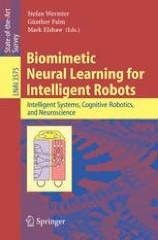
Biomimetic neural learning for intelligent robots : Intelligent systems, cognitive robotics, and neuroscience
This book presents research performed as part of the EU project on biomimeticmultimodal learning in a mirror neuron-based robot (MirrorBot) and contribu-tions presented at the International AI-Workshop on NeuroBotics. The over-all aim of the book is to present a broad spectrum of current research intobiomimetic neural learning for intelligent autonomous robots. In this book we show the development of newtechniques using cell assemblies, associative neural networks, and Hebbian-typelearning in order to associate vision, language and motor concepts. We havedeveloped biomimetic multimodal learning and language instruction in a robotto investigate the task of searching for objects. As well as the research performedin this area for the MirrorBot project, the second part of this book incorporatessignificant contributions from other research in the field of biomimetic robotics.This second part of the book concentrates on the progress made in neuroscienceinspired robotic learning approaches (in short: NeuroBotics). We hope that this book stimulates and encourages new research in this in-teresting and dynamic area.
Biometric systems : Technology, design and performance evaluation
The use of computers to recognize humans from physical and behavioral traits dates back to the digital computer evolution of the 1960s. But even after decades of research and hundreds of major deployments, the field of biometrics remains fresh and exciting as new technologies are developed andoldtechnologiesareimprovedandfieldedinnewapplications.Wor- wide over the past few years,there has been a marked increase in both g- ernment and private sector interest in large-scale biometric deployments for accelerating human–machine processes, efficiently delivering human services, fighting identity fraud and even combating terrorism. The p- pose of this book is to explore the current state of the art in biometrics- tems and it is the system aspect that we have wished to emphasize. By their nature, biometric technologies sit at the exact boundary of the human–machineinterface.Butlikealltechnologies,bythemselvestheycan provide no value until deployed in a system with support hardware, n- work connections, computers, policies and procedures, all tuned together to work withpeople to improve some real business process within a social structure.
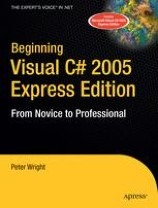
Beginning Visual C# 2005 Express ed. : From novice to professional
Wright took the same approach with this book that he did with the VB titles, and inside you'll find a fast–paced guide to the essentials to get you programming fast. You'll learn the C# language and the tools Visual C# 2005 Express provides. He covers everything from simple console programs to code that talks to the Internet, and even how to write your own database programs. Whatever your reasons for wanting to learn to program with C#, this book will get you where you want to be quickly, and hopefully with a smile on your face. So dive in and change the way you use computers forever.
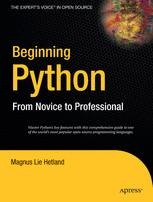
Beginning Python : From novice to professional
Ten different projects illustrate the concepts introduced in the book. You will learn how to create a P2P file-sharing application and a web-based bulletin board, and how to remotely edit web-based documents and create games. Author Magnus Lie Hetland is an authority on Python and previously authored Practical Python. He also authored the popular online guide, Instant Python Hacking, on which both books are base
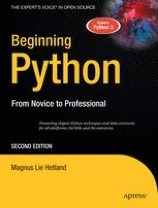
Beginning Python : From novice to professional
Gain a fundamental understanding of Python's syntax and features with the second edition of Beginning Python, an up–to–date introduction and practical reference. Covering a wide array of Python–related programming topics, including addressing language internals, database integration, network programming, and web services, you'll be guided by sound development principles. Ten accompanying projects will ensure you can get your hands dirty in no time. Updated to reflect the latest in Python programming paradigms and several of the most crucial features found in Python 3.0 (otherwise known as Python 3000), advanced topics, such as extending Python and packaging/distributing Python applications, are also covered
