


تحسين النتائح
ترتيب حسب
من
الى

Stats with an introduction to AI, where you’ll learn the history of neural networks and what sets deep learning apart from other varieties of machine learning. Discovery the variety of deep learning frameworks and set-up a deep learning development environment. Next, you’ll jump into simple classification programs for hand-writing analysis. Once you’ve tackled the basics of deep learning, you move on to TensorFlow 2 specifically. Find out what exactly a Tensor is and how to work with MNIST datasets. Finally, you’ll get into the heavy lifting of programming neural networks and working with a wide variety of neural network types such as GANs and RNNs. Deep Learning is a new area of Machine Learning research widely used in popular applications, such as voice assistant and self-driving cars. Work through the hands-on material in this book and become a TensorFlow programmer! You will: Develop using deep learning algorithms Build deep learning models using TensorFlow 2 Create classification systems and other, practical deep learning applications

Learn foundational and advanced topics in Neural Processing Unit design with real-world examples from leading voices in the field. A thorough introduction to neural networks and neural network development history, as well as Convolutional Neural Network (CNN) models Explorations of various parallel architectures, including the Intel CPU, Nvidia GPU, Google TPU, and Microsoft NPU, emphasizing hardware and software integration for performance improvement Discussions of streaming graph for massive parallel computation with the Blaize GSP and Graphcore IPU An examination of how to optimize convolution with UCLA Deep Convolutional Neural Network accelerator filter decomposition
Constitutes the refereed proceedings of the First international workshop on ai in Drug Discovery, AIDD 2024, held as a part of the 33rd International Conference on Artificial Neural Networks, ICANN 2024, in Lugano, Switzerland, on September 19, 2024. These papers focus on various aspects of the rapidly evolving field of Artificial Intelligence (AI)-driven drug discovery in chemistry, including Big Data and advanced Machine Learning, eXplainable AI (XAI), Chemoinformatics, Use of deep learning to predict molecular properties, Modeling and prediction of chemical reaction data and Generative models.
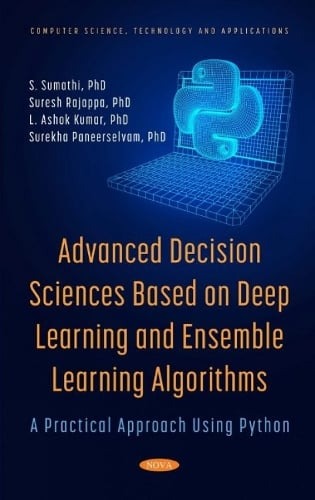
Describes the deep learning models and ensemble approaches applied to decision-making problems. The authors have addressed the concepts of deep learning, convolutional neural networks, recurrent neural networks, and ensemble learning in a practical sense providing complete code and implementation for several real-world examples. The authors of this book teach the concepts of machine learning for undergraduate and graduate-level classes and have worked with Fortune 500 clients to formulate data analytics strategies and operationalise these strategies.
The book consists of two parts: the first discusses the fundamentals of matrix algebra in detail, while the second focuses on the applications of matrix algebra approaches in AI. Highlighting matrix algebra in graph-based learning and embedding, network embedding, convolutional neural networks and Pareto optimization theory, and discussing recent topics and advances, the book offers a valuable resource for scientists, engineers, and graduate students in various disciplines
Discrete-time signal processing has had a momentous impact on advances in engineering and science over recent decades. The rapid progress of digital and mixed-signal integrated circuits in processing speed, functionality and cost-effectiveness has led to their ubiquitous employment in signal processing and transmission in diverse milieux. Topics covered include: • SISO, MIMO and 2-d non-blind equalization (deconvolution) algorithms. • SISO, MIMO and 2-d blind equalization (deconvolution) algorithms. • SISO, MIMO and 2-d blind system identification algorithms. • algorithm analyses and improvements. • applications of SISO, MIMO and 2-d blind equalization/identification algorithms.
Various aspects of numerical analysis for equations arising in boundary integral equation methods have been the subject of several books published in the last 15 years [95, 102, 183, 196, 198]. Prominent examples include various classes of o- dimensional singular integral equations or equations related to single and double layer potentials. Usually, a mathematically rigorous foundation and error analysis for the approximate solution of such equations is by no means an easy task. One reason is the fact that boundary integral operators generally are neither integral operatorsof the formidentity plus compact operatornor identity plus an operator with a small norm. Consequently, existing standard theories for the numerical analysis of Fredholm integral equations of the second kind are not applicable. In the last 15 years it became clear that the Banach algebra technique is a powerful tool to analyze the stability problem for relevant approximation methods [102, 103, 183, 189]. The starting point for this approach is the observation that the ? stability problem is an invertibility problem in a certain BanachorC -algebra. As a rule, this algebra is very complicated – and one has to ?nd relevant subalgebras to use such tools as local principles and representation theory.

After publishing an introduction to the Navier–Stokes equation and oceanography (Vol. 1 of this series), Luc Tartar follows with another set of lecture notes based on a graduate course in two parts, as indicated by the title. A draft has been available on the internet for a few years. The author has now revised and polished it into a text accessible to a larger audience.

This volume contains 23 articles on algebraic analysis of differential equations and related topics, most of which were presented as papers at the international conference "Algebraic Analysis of Differential Equations – from Microlocal Analysis to Exponential Asymptotics" at Kyoto University in 2005. Microlocal analysis and exponential asymptotics are intimately connected and provide powerful tools that have been applied to linear and non-linear differential equations as well as many related fields such as real and complex analysis, integral transforms, spectral theory, inverse problems, integrable systems, and mathematical physics. The articles contained here present many new results and ideas, providing interested researchers and students with valuable suggestions and instructive guidance for their work.

سوريا - اتستراد درعا - غباغب
+963-15 2050 - 15 860 380 /1/2/3 - 11 662 3900