


تحسين النتائح
ترتيب حسب
من
الى

The increasingly complex environment of today's world, characterized by technological innovation and global communication, generates myriads of possible and actual interactions while limited physical and intellectual resources severely impinge on decision makers, be it in the public or private domains. At the core of the decision-making process is the need for quality information that allows the decision maker to better assess the impact of decisions in terms of outcomes, nonlinear feedback processes and time delays on the performance of the complex system invoked.
This book explores the possibilities of applying the theories of complexity and self-organization developed to account for various phenomena in the natural science to artifacts traditionally the realm of humanities and social sciences. The emphasis of this volume is on the development of cities and the impact of these methods on urban simulation methods.
We are living in an ever more complex world, an epoch where human actions can accordingly acquire far-reaching potentialities. Complex and adaptive dynamical systems are ubiquitous in the world surrounding us and require us to adapt to new realities and the way of dealing with them. This primer has been developed with the aim of conveying a wide range of "commons-sense" knowledge in the field of quantitative complex system science at an introductory level, providing an entry point to this both fascinating and vitally important subject.
The guiding principle of this presentation of ``Classical Complex Analysis'' is to proceed as quickly as possible to the central results while using a small number of notions and concepts from other fields. Thus the prerequisites for understanding this book are minimal; only elementary facts of calculus and algebra are required.

Mechanics, Electrodynamics, Quantum Mechanics, and Statistical Mechanics and Thermodynamics comprise the canonical undergraduate curriculum of theoretical physics. In Compendium of Theoretical Physics, Armin Wachter and Henning Hoeber offer a concise, rigorous and structured overview that will be invaluable for students preparing for their qualifying examinations, readers needing a supplement to standard textbooks, and research or industrial physicists seeking a bridge between extensive textbooks and formula books. The authors take an axiomatic-deductive approach to each topic, starting the discussion of each theory with its fundamental equations. By subsequently deriving the various physical relationships and laws in logical rather than chronological order, and by using a consistent presentation and notation throughout, they emphasize the connections between the individual theories. The reader’s understanding is then reinforced with exercises, solutions and topic summaries.

In This book, Compendium of Chemical Warfare Agents, author Steven L. Hoenig provides all the necessary information that First Responders, Hospitals, HazMat Teams, Fire and Rescue Services, and other First Responders need to know when dealing with dangerous chemical agents.Coverage includes health effects, physical characteristics, hazards from reactivity, protection of personnel, and general first aid for each agent. The book provides quick and easy access to critical data on chemical warfare agents, both at the scene of release and in the laboratory.
The book provides a state-of-the-art overview of important theories from mathematics education and the broad variety of empirical approaches currently widely used in mathematics education research.
The book – the first of its kind – establishes new theory and knowledge in the area of third sector organizations (TSOs) in Asia. The main purpose of this book is to draw the attention of Asia's TSOs on the importance of good governance. It documents variety of approaches, and identifies socio-cultural, economic, and political dynamics and impacts of different models of TSO governance. The combined information from the contributions in this work will ensure the sustainability of TSOs throughout Asia.
It is fairly easy for a Finnish Jurist to understand German Company law. On the other hand, UK Company law seems very confusing. What is even more confusing is that the UK corporate govemance model is often regarded as one of the best in the World. Clearly German law cannot be as bad as it is often said to be. This books results from these kinds of thoughts and an interest in comparative law, Company law and securities markets law. I wanted to find out whether the functional method would give anything new to say about the regulation of corpo rate govemance in Germany and the UK. As I have been lecturing on Company law and corporate govemance myself, I also wanted to write a book that I could use as a textbook in my courses. For this reason, I focused on one of the key questions in corporate govemance: the regula tion of shareholder activism.

This book critically examines equality, equity and democracy in education, globally as well as from various perspectives. Globally, there are increasing arguments both for the democratization of education and for the use of education to promote a democratic society. It is argued that democratic schools would better prepare for active citizenship and for a strong civil society which are seen to be the foundation of a democratic state. The book further argues that while there are inspiring examples of schools that engage in peace education or emancipatory pedagogy that work across various ethnic or religious divides, on balance, the forms, structures, ideologies and purposes of formal education interact to make national and international conflict more likely.
Noncompact symmetric and locally symmetric spaces naturally appear in many mathematical theories, including analysis (representation theory, nonabelian harmonic analysis), number theory (automorphic forms), algebraic geometry (modulae) and algebraic topology (cohomology of discrete groups). In most applications it is necessary to form an appropriate compactification of the space. The literature dealing with such compactifications is vast. The main purpose of this book is to introduce uniform constructions of most of the known compactifications with emphasis on their geometric and topological structures. The book is divided into three parts. Part I studies compactifications of Riemannian symmetric spaces and their arithmetic quotients. Part II is a study of compact smooth manifolds. Part III studies the compactification of locally symmetric spaces.
Although Riemann surfaces are a time-honoured field, this book is novel in its broad perspective that systematically explores the connection with other fields of mathematics. It can serve as an introduction to contemporary mathematics as a whole as it develops background material from algebraic topology, differential geometry, the calculus of variations, elliptic PDE, and algebraic geometry. It is unique among textbooks on Riemann surfaces in including an introduction to Teichmüller theory.
Over the past decade, community schools similar to those supported by Save the Children have been established in many developing countries, and especially in sub-Saharan Africa. As large numbers of children attend schools started and managed by their own communities and/or by nongovernmental organizations, questions have come up about the impact of such schools at large scale: "Can village-based or community schools have a national impact on access to education, spur improved long-term development strategies and education policy, or achieve or influence Education for All? This book explores these and related questions, drawing on Save the Children’s experience with community-based schooling in four countries: Ethiopia, Malawi, Mali, and Uganda.
This book provides new thinking on scientific identity formation. It thoroughly interrogates the concepts of community and identity, including both historical and contemporaneous analyses of several scientific fields.
This open access volume is about how to research the influence of our changing media environment. Today, there is not one single medium that is the driving force of change. With the spreading of various technical communication media such as mobile phone and internet platforms, we are confronted with a media manifold of deep mediatization. But how can we investigate its transformative capability? This book answers this question by taking a non-media-centric perspective, researching the various figurations of collectivities and organizations humans are involved in. The first part of the book outlines a fundamental understanding of the changing media environment of deep mediatization and its transformative capacity. The second part focuses on collectivities and movements: communities in the city, critical social movements, maker, online gaming groups and networked groups of young people. The third part moves institutions and organizations into the foreground, discussing the transformation of journalism, religion, politics, and education, whilst the fourth and final part is dedicated to methodologies and perspectives.
Presents main concepts of mobile communication systems, both analog and digitalIntroduces concepts of probability, random variables and stochastic processes and their applications to the analysis of linear systemsIncludes five appendices covering Fourier series and transforms, GSM cellular systems and more
Designed for senior electrical engineering students, this textbook explores the theoretical concepts of digital signal processing and communication systems, using practical laboratory experiments with real-time DSP hardware.
The book chapters represent review articles covering the most relevant areas of the field. They are written with the goal of providing students with comprehensive introductions. Further they offer a supply of numerous references to the relevant literature. Besides its usefulness as a textbook, this will make the book a source of valuable information for those who want to improve or refresh their knowledge in the field of communication acoustics – and to work their way deeper into it. Due to its interdisciplinary character Communication Acoustics is bound to attract readers from many different areas, such as: acoustics, cognitive science, speech science, and communication technology.
illustrates the benefits to be gained from digitally networked communication for health, education and transitioning economies in developing nations (Sierra Leone and Papua New Guinea) and developed nations. Growing powers of e-citizenship can help build sustainable futures. This small volume provides a collection of examples and ideas from which the authors hope will help build a wider resource. Understanding how to link everyday lives with global networks in the digital world in ways that add benefit for the world’s people, and the health of the planet, is an ongoing project. IYGU recognises the integral roles of networking and communication systems, as well as interactions between people, near and far, as fundamental for building better futures. The global penetration of digital devices means everyday life, present and future, is inextricably linked with information technologies
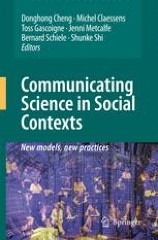
Science communication, as a multidisciplinary field, has developed remarkably in recent years. It is now a distinct and exceedingly dynamic science that melds theoretical approaches with practical experience. Formerly well-established theoretical models now seem out of step with the social reality of the sciences, and the previously clear-cut delineations and interacting domains between cultural fields have blurred. Communicating Science in Social Contexts examines that shift, which itself depicts a profound recomposition of knowledge fields, activities and dissemination practices, and the value accorded to science and technology.

سوريا - اتستراد درعا - غباغب
+963-15 2050 - 15 860 380 /1/2/3 - 11 662 3900