


تحسين النتائح
ترتيب حسب
من
الى

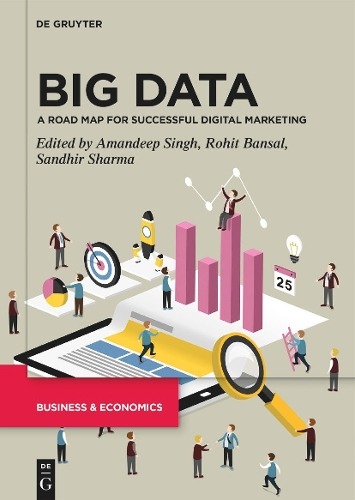
Explores recent trends in the use of big data to predict consumer behavior, strategies to engage online customers, integration of big data with other data sources, and its applications in social media analytics, mobile marketing, search engine optimization and customer relationship management.
Explores recent trends in the use of big data to predict consumer behavior, strategies to engage online customers, integration of big data with other data sources, and its applications in social media analytics, mobile marketing, search engine optimization and customer relationship management.

Investigates why, despite more and more resources devoted to safety training, expectations are not entirely met, particularly in the industrial sectors that have already achieved a high safety level. It not only reflects the most precious viewpoints of experts from different disciplines, different countries, with experiences in various industrial fields at the cutting edge of theories and practices in terms of safety, professionalization and their relationships. It also consolidates the positioning of the Foundation for an Industrial Safety Culture, highlighting what is currently considered at stake in terms of safety training, taking into account the system of constraints the different stakeholders are submitted to. It reports some success stories as well as elements which could explain the observed plateau in terms of outcome. It identifies some levers for evolution for at-risk industry and outlines a possible research agenda to go further with experimental solutions.
This book examines the capabilities needed to transform a globally distributed organization into a virtual organization (an organization that exists and operates across time and distance with the support of global communications technologies such as the Internet). It introduces techniques for definition of goals for virtualization, for monitoring progress toward virtualization and for studying the impact of virtualization on social uncertainty, knowledge sharing and knowledge transfer, organizational memory, transactive memory, communities of practice and organizational commitment, power and control. These techniques are applied in an extended case study of a development aid organization's attempts to use knowledge management for virtualization over a two year period. The multidisciplinary team of authors examines virtualization from points of view ranging from the organizational to the technological to the sociological and psychological.

The aim of this dissertation is to examine bargaining power effects in financial contracting. In particular power effects on firms' choices of contract type (debt vs. equity) and placement mode (public offering vs. private placement)

In the German banking sector, management is continually increasing its focus on shareholder interests. This can be seen in the ambitious profitability targets set by management in this sector. Some municipalities are also putting increasing pressure on Landesbanks and saving banks, as members of the largest German banking group, to create greater financial value.
Banking Sector Liberalization in India explores in detail the changes in the Indian banking sector over the last 20 years, and puts them into a comparative perspective with the Chinese banking sector. For this purpose, the author develops a detailed indicator-based framework for assessing the liberalization of a banking sector along various process steps based on financial liberalization and transformation studies. This framework, along with the indicators for the process and the results of liberalization, is applied to the banking sectors in India and China to test for the effects of liberalization on the sector and the macro level. The key finding is that while liberalization has improved the sectoral performance, it has so far had no effect on the macro level. The book features a detailed description of recent reforms in the Indian banking sector, a set of indicators for evaluating banking sector reforms, and a large number of graphs with key figures for the banking sectors in India and China.
Provides a tailored overview of what AI specifically means for financial services, a highly regulated yet also disrupted industry. it investigates the current state of AI applications in financial services today along with the state of funding and partnerships between tech and banking industries. it also examines the key pillars of responsible AI and the importance of keeping humans in the loop. the book takes a deep dive into the use cases in the financial services industry, the challenges and opportunities, and the fragmented regulatory landscape. how can we effectively assess risks, and balance innovation and customer centricity with trust in AI in financial services? can smaller organizations reap the benefits of the technology? how can institutions deploy AI responsibly and securely, and promote a fairer and more equitable future for more people?

Hints of globalization have actually been around for several decades, even though they made only a modest impact; however, the availability of global capital and advances in communication technology have emp- sized the process of internationalization and the tools available to connect and integrate business activities to answer to more complex needs of c- ents. Moreover, the financial scandals and the review of mutual fund trade activity in the US by the Attorney General Elliot Spitzer have highlighted the importance to focus all efforts on renewing the confidence of prof- sional investors and their clients who have entrusted their capital to asset managers. Therefore, there is a growing need in the market to reinforce the concept of “Shared Positive Values” among the entire industry and among its stakeholders.

Covers the basics of business-to-business (B2B) eCommerce, where similar principles of customer targeting can be observed as in B2C eCommerce. Gerrit Heinemann highlights the specifics and business models of B2B eCommerce, analyzes the digital challenges and shows the consequences and opportunities for online sales in B2B. Recognised best-practice examples illustrate how successful B2B eCommerce can work and which risks have to be considered.

Our book is one of the first to probe deeply into the art and science of branding industrial products. We provide the concepts, the theory, and dozens of cases illustrating the successful branding of industrial goods.

In this book, scholars from a range of disciplines argue that the asset—meaning anything that can be controlled, traded, and capitalized as a revenue stream—has become the primary basis of technoscientific capitalism. An asset can be an object or an experience, a sum of money or a life form, a patent or a bodily function. A process of assetization prevails, imposing investment and return as the key rationale, and overtaking commodification and its speculative logic. Although assets can be bought and sold, the point is to get a durable economic rent from them rather than make a killing on the market. Assetization examines how assets are constructed and how a variety of things can be turned into assets, analyzing the interests, activities, skills, organizations, and relations entangled in this process.
This book investigates the origins and evolution of Asia’s new institutional architecture in trade, finance, and security from both a theoretical and empirical perspective. The traditional institutional equilibrium in Asia has come under heavy strain in the "post triple shocks period" - the post-Cold War, the post-financial crisis of 1997-98, and the post-9-11 attacks. The new dynamics of rivalry and cooperation among states at both the intraregional and transregional levels is now shaping a new institutional architecture. Political and business leaders from Northeast and Southeast Asia interact with each other more frequently. South Asia’s participation in the rest of Asia in recent years is truly impressive. As we show, the future institutional trajectory of Asia is still open, but we believe that the book provides a timely examination of key shifts in the region. In doing so, our hope is to provide policymakers and analysts with an institutional road map for the future.

The book has three parts. Part I describes the characteristics and historical origins of these markets. Part II examines the contemporary bond markets and shows how they contribute to general welfare, describes the relationship between the banking sector and capital markets, and assesses prospects for reform in Asia's governmental and corporate debt markets. Part III explains the micro-level impediments and obstacles that must be the first targets of any reform efforts, provides an appraisal of attempts at regional cooperation to stimulate structural reform, and lastly contributes proposals to accelerate the growth and reach of bond markets throughout Asia.

Topicality of Asian economy has refused to fade for almost four decades; if anything it has been levitating. The Asian economy has changed markedly since the economic and financial crisis of 1997-1998 and is continuing to evolve. As a scholarly subject matter, Asian economy has not stopped attracting academicians, policy mandarins, decision makers in the arena of business and students of Asian economy. The Asian crisis was a cataclysmic event for the region and brought to the surface several systemic limitations, like those in the financial sector, corporate governance, regulatory oversight, legal framework, and exchange rate management. Managers of Asian economy need to get to the bottom of these acutely problematical systemic issues. Additionally, Asian economies need to change with the demands of time and devise their post-crisis development strategy. Asia’s growth model, that served it so well for four decades, is overdue for renewal so that it can re-strengthen its bonds with the ever-evolving regional and global economic reality. The old growth model is likely to be less relevant and effective in the post-crisis future of the Asian economies. It is sure to run into the wall of diminishing returns.

Explores the past, present, and future of artificiality and sustainability in entrepreneurship – the unforeseen consequences and ways to advance to a sustainable future. In particular, it connects artificiality, sustainability and entrepreneurship, intertwining artificial with the specific phenomenon of those novel digital technologies that provoke continuous and significant change in our lives and business. Unlike digital entrepreneurship research, which focuses on digital technology development and management, this book covers processes and mechanisms of sustainable adaptability of entrepreneurs, the business logic of start-ups, and the collaborative behaviours under the mass digital transformation, including the prevalence of artificial intelligence. Some of the questions that this book answers are as follows: How has entrepreneurship reacted to such challenges previously? What lessons have been learned and need to be carried forward? How can entrepreneurship and the artefacts of entrepreneurship respond to current challenges? What should be the mindset of the entrepreneur to assure sustainable adaptation? How to embrace and embed the new business logic?
Agent-based computational modeling with its intrinsic multidisciplinary approach is gaining increasing recognition in the social sciences, particularly in economics, business and finance. This volume is devoted to recent contributions to the field from both the social sciences and computer sciences.
Artificial intelligence (AI) has driven businesses to adopt new business practices rapidly, enhance product development and services, has helped to power AI-based market intelligence and customer insights, and improve customer relationship management. This timely book addresses the use of AI in marketing.

Containing tips, techniques and short cuts gained from practical experience, this book show how to use ARIS in an easy way, supporting smart methods and smart models, and displays how ARIS can be used as a powerful tool for BPM.

ARIS is ranked as the leading Business Process Modelling tool in the Gartner Quadrant for Business Process Analysis and Optimization. The ARIS Design Platform is being used as a business process management (BPM) tool for projects in BPM, quality management, business analysis and design, software development, implementation of service-oriented architectures and so forth. Following on from Rob Davis’ successful introductory text, ARIS Design Platform: Getting Started with BPM, this new book covers in detail some of the more advanced concepts of using ARIS Business Architect in the new ARIS 7 Design Platform. Written in a reader-friendly style, it contains detailed explanations of key concepts combined with numerous examples, hints and tips gained from many years of practical experience of using ARIS.

سوريا - اتستراد درعا - غباغب
+963-15 2050 - 15 860 380 /1/2/3 - 11 662 3900